
Tracking Dusty Vineyards with the Agras T70P
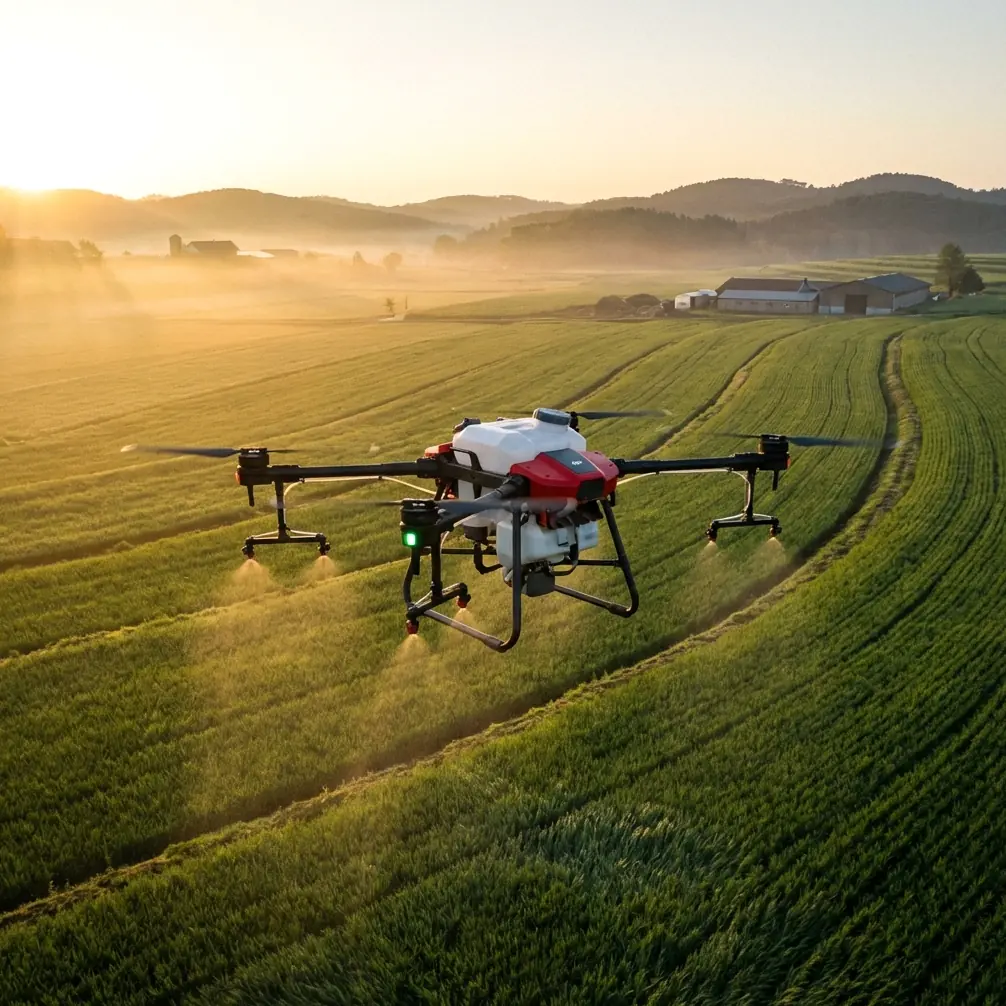
Tracking Dusty Vineyards with the Agras T70P: What Actually Matters When Conditions Shift Mid-Flight
META: A field-focused look at using the Agras T70P in dusty vineyard conditions, covering stability, flight planning, spray accuracy, RTK precision, payload sensing, and why propulsion and imaging quality matter when weather changes.
Dust is unforgiving in vineyards.
It creeps into workflow long before it becomes visible in the air. It softens image quality, complicates canopy interpretation, affects spray deposition, and turns a routine mission into a test of whether the aircraft, the mission plan, and the operator are working as one system. For anyone evaluating the Agras T70P for vineyard operations, especially in dry blocks where wind and dust can build quickly, the real question is not whether the platform can fly. It is whether it can keep data quality and application accuracy intact when the environment stops cooperating.
That is the lens through which the T70P should be judged.
The vineyard problem is not just coverage
Vineyard managers often frame drone work around acreage covered per hour. That is understandable, but incomplete. In practice, tracking vineyard condition in dusty terrain usually involves a chain of tasks: route design between narrow rows, stable low-altitude flight, reliable image capture, precise positioning, and often a follow-up spray mission where drift control and nozzle calibration become just as important as raw throughput.
A drone can have an impressive swath width on paper and still underperform if canopy edges are inconsistently mapped or if mid-flight gusts shake the aircraft enough to degrade sensor output. One of the more useful reminders from agricultural UAV research is that these aircraft are not simple camera tripods in the sky. They are described as nonlinear, multivariable, highly coupled, and underactuated systems. That sounds academic, but in the vineyard it translates into something very practical: small disturbances can ripple across flight attitude, imaging stability, and mission consistency.
The T70P belongs in this conversation because vineyard work rewards platforms that hold attitude well, maintain predictable track spacing, and recover cleanly from changing air conditions without introducing visible inconsistency into the mission.
What changed mid-flight in our scenario
Picture a late-morning vineyard block after several dry days. The first pass is smooth. RTK lock is solid, row alignment looks clean, and the aircraft is tracking a preplanned route with centimeter-level intent. Then the weather shifts. Not a storm, not an emergency, just the kind of mid-flight change every serious operator has seen: a rise in crosswind, a slight thermal bump off exposed soil, and a dust plume developing along the tractor lane.
This is where weaker setups start to unravel.
The immediate issue is rarely “can the drone stay airborne?” The bigger concern is whether the aircraft can hold its flight path tightly enough to preserve overlap, maintain consistent height over uneven terrain, and keep payload output useful. In agricultural flight-control literature, attitude stability is treated as critical precisely because airflow disturbance, gravity effects, gyroscopic behavior, and rotor inertia all act on a small airframe at once. Add vibration from the platform itself, and image transmission or acquisition can begin to show jitter. The research is explicit on another point too: vibration mitigation matters because it reduces shake and unstable image signals during capture and transmission.
Operationally, that means a T70P mission in dusty vineyards should be planned and interpreted as a stability exercise first, not just a logistics exercise.
Why pre-flight route design matters more than people admit
One of the strongest insights from the reference material is about trajectory planning. In agricultural information-gathering missions, route design is not just a convenience feature. It is the mechanism for controlling flight height, turning radius, and total flight distance while also supporting positioning, display, recording, and the handling of multiple mission data streams.
That matters directly to the Agras T70P.
In vineyards, row structure creates a deceptively complex geometry. Blocks may be narrow, terraced, irregular at the edges, or interrupted by service roads and elevation changes. If you wait to solve that in the air, you are already behind. The better approach is what the research identifies as pre-planning through the ground station, rather than relying on more difficult online autonomous path generation. For practical vineyard work, this means building a route before takeoff that minimizes uneven overlap, respects turning constraints at row ends, and anticipates wind exposure zones.
When the weather changed mid-flight in our scenario, the reason the mission stayed useful was not luck. It was route discipline. A preplanned track with controlled spacing gives the aircraft less ambiguity to resolve while the environment gets messy. For mapping, that preserves alignment. For spraying, it helps maintain more consistent application geometry and reduces the chance of under-treated or over-treated strips.
Dust, vibration, and payload quality: the hidden weak link
A lot of buyers ask about tank size, flow rate, or coverage efficiency first. In dusty vineyards, payload quality often deserves equal billing.
The hyperspectral reference in the source set is revealing here, even though it comes from water-quality work rather than vineyards. It notes that remote sensing accuracy depends heavily on the quality and resolution of the source data. It also highlights a core limitation of many traditional datasets: insufficient spectral resolution or limited detection range can reduce the usefulness of the result. In the water-monitoring example, researchers discuss three main retrieval approaches for chlorophyll-a concentration—empirical, semi-analytical, and analytical—and explain why the analytical route is often constrained by the difficulty of obtaining large amounts of near-synchronous atmospheric and optical property data. The practical takeaway is broader than the lake example itself: high-quality sensing only works when the collection conditions and support data are good enough.
Bring that back to vineyards.
If the T70P is part of a broader crop-monitoring workflow, whether through multispectral payloads, scouting integration, or zone-based treatment planning, then stable collection conditions are not optional. Dust and vibration both erode the quality of what you are trying to infer from the crop. You may still get images, but the decision value can drop. In a vineyard, that can affect detection of stress patterns, vigor variability, irrigation inconsistency, or disease onset along specific rows.
So the aircraft’s ability to stay settled when the wind shifts is not just a piloting comfort metric. It directly affects agronomic confidence.
Propulsion matters, even if you only care about field results
Another useful detail from the agricultural UAV reference is often overlooked: aircraft mass is a major factor in endurance, and the power and energy system takes up a large proportion of total weight. The same document notes that many small electric UAVs typically offer only around 10–30 minutes of endurance, with much of the stored energy consumed by propulsion.
Why mention that in an article about the Agras T70P?
Because propulsion is not an abstract engineering topic when you are tracking vineyards in dust. It influences how long you can stay on mission, how much reserve you keep when weather degrades, how much payload flexibility you have, and how confidently you can maintain stable operating margins near the end of a job. The source material also lists internal combustion engines, electric motor systems, and microturbines as available power approaches, while pointing out tradeoffs in controllability, maturity, and efficiency.
That makes the recent Yunnan rotor-engine news particularly interesting. According to the source, a school-enterprise consortium in Yunnan says it has mastered core UAV rotary-engine technology and achieved industrialization, becoming the first such consortium in Yunnan and the second nationwide to do so. It also states that this is an independently developed rotor engine and that the institution plans to deepen industry-education integration with enterprise partners.
This is not a direct T70P specification point, and it should not be treated as one. But it is operationally significant for the market around aircraft like the T70P. Why? Because it signals continued domestic movement in one of the hardest parts of drone performance: propulsion. In dusty, high-workload agricultural operations, better engine technology can eventually influence endurance, payload options, serviceability, and the viability of hybrid mission profiles. Even electric-first operators should watch this closely. The future of agricultural UAV capability will not be determined by airframe design alone.
Spray drift in vineyards is a control problem before it is a chemistry problem
Once the tracking pass is done, many vineyard operators use the same mission intelligence to guide treatment. That is where the T70P conversation quickly turns toward spray drift, nozzle calibration, and swath width.
Dusty blocks usually come with variable airflow. Wind can accelerate through row corridors and lift off bare soil patches, making droplets behave differently at one section of the vineyard than the next. The temptation is to fix this after the fact by increasing volume or changing pass spacing too aggressively. Usually, that creates a new problem.
A better interpretation is that drift management starts with path accuracy and aircraft stability. If the drone holds its intended altitude and speed consistently, nozzle calibration becomes meaningful because the application conditions are repeatable enough to trust the calibration. If the aircraft is hunting in pitch or wandering laterally, even a carefully tuned spray setup can produce inconsistent canopy coverage.
This is where RTK fix rate and centimeter precision stop being buzzwords. They matter because repeated, row-faithful passes reduce uncertainty. In vineyards, especially with uneven row spacing or edge tapering, precise navigation supports cleaner re-entry into specific treatment zones and more reliable sectional work. That helps when you are trying to limit overlap at the headland or avoid pushing drift beyond the intended canopy.
IPX6K matters in the real world for one simple reason
Dusty vineyards are rarely just dusty.
They are dusty in the morning, then damp after cleaning, then exposed to tank splash, residue, and routine washdown at the end of the day. That is why ruggedization details like IPX6K deserve attention. Not because ingress ratings solve every maintenance issue, but because agricultural drones are not used in laboratory conditions. They are exposed to abrasive particles, liquids, residues, and repetitive cleaning cycles. A platform built to tolerate harsh washdown and contamination pressure is easier to keep mission-ready over time.
For operators running frequent sorties during a tight disease window or nutrient application schedule, uptime is not a convenience metric. It is part of agronomic timing.
What the mid-flight weather shift taught us about the T70P
When the crosswind rose and dust started moving through the lane, the mission outcome depended on a few fundamentals:
- the route had already been planned with vineyard geometry in mind
- the aircraft could maintain a disciplined track rather than improvising around every disturbance
- the payload output remained usable because vibration and attitude shifts stayed controlled
- precision navigation preserved repeatability as conditions changed
That combination is what separates a field-ready platform from a spec-sheet favorite.
If you are evaluating the Agras T70P for vineyard tracking, do not reduce the decision to capacity or speed alone. Ask harder questions. How well does it protect data quality when airflow turns unstable? How reliably can it hold row alignment for repeated spray or scouting passes? How easily can you tune nozzle calibration around real canopy structure instead of textbook assumptions? How fast can your team reconfigure a mission when dust and weather alter the workable window?
Those are the questions that show whether the aircraft fits your operation.
A practical way to think about the T70P in dusty vineyards
The strongest case for the T70P is not that it can do everything. It is that it sits at the intersection of three needs vineyard operators care about:
Stable execution in imperfect air
Agricultural UAV research makes clear that disturbance rejection and flight-control quality are central, not optional. In vineyards, that directly affects both imaging and spray consistency.Mission planning that respects geometry and limits
The source material emphasizes planning around task requirements, aircraft characteristics, and operating constraints such as distance and turns. That maps directly onto row-based flying where overlap and headland behavior can make or break a mission.A broader technology ecosystem that is still advancing
The Yunnan rotary-engine milestone is a reminder that propulsion innovation remains active. Even when discussing a current platform like the T70P, future support, endurance logic, and agricultural UAV performance trends should be part of the conversation.
If you are building a vineyard workflow and want to compare route strategy, spray setup, or sensor pairing for dusty blocks, you can message a field specialist here and discuss the mission profile rather than just the aircraft headline specs.
That is the right level to evaluate a machine like the Agras T70P. Not as a generic farm drone. As a system expected to keep performing when the vineyard, the weather, and the schedule all apply pressure at the same time.
Ready for your own Agras T70P? Contact our team for expert consultation.