
Agras T70P for Mountain Vineyards: Flight Altitude
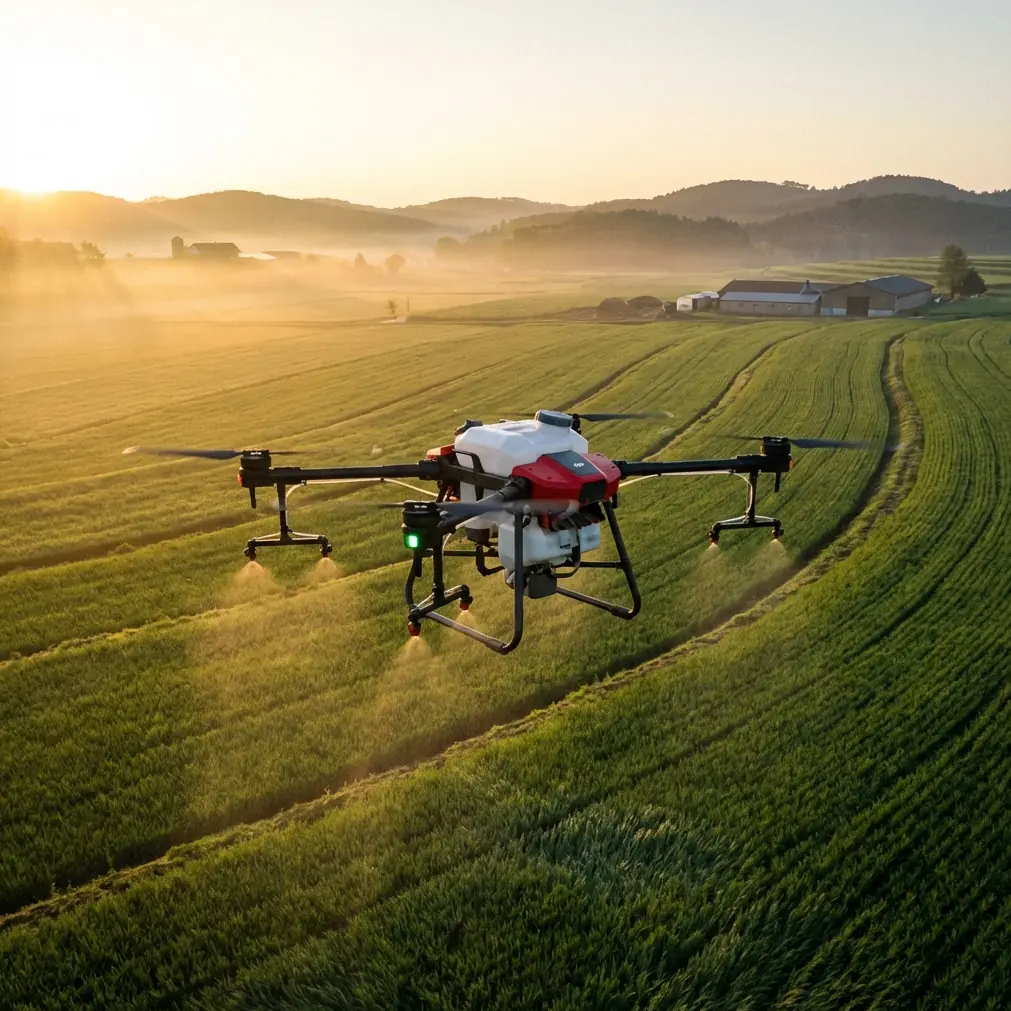
Agras T70P for Mountain Vineyards: Flight Altitude, Drift Control, and Precision Setup That Actually Works
META: Practical Agras T70P tutorial for mountain vineyards, covering optimal flight altitude, spray drift control, RTK precision, nozzle calibration, multispectral workflow, and reliable operations on steep terrain.
Mountain vineyards punish sloppy drone setup.
Rows bend with the contour of the slope. Wind curls upward off the face of the hill, then drops cold air into the next block. Trellis height changes just enough to ruin a “standard” pass height, and spray drift becomes a real agronomic and compliance problem the moment you treat near an exposed edge. If you are planning to use the Agras T70P in this environment, the question is not whether it can cover the ground. The question is how to make it hold a stable, productive pattern when the terrain keeps trying to trick the aircraft.
I work with growers and operators who often arrive at the same assumption: if the drone is powerful enough, the hard part is solved. In mountain viticulture, power is only part of the story. Precision, droplet behavior, terrain-following discipline, and repeatable setup matter more than headline capability. The T70P can be highly effective here, but only if you tune the mission around the vineyard rather than forcing the vineyard to fit a flat-field workflow.
This guide focuses on the one setup choice that has the biggest downstream effect in steep vineyards: flight altitude. From there, I will connect it to swath width, nozzle calibration, RTK fix quality, and how multispectral scouting can sharpen your spray decisions before the rotors ever spin.
Start With the Right Height, Not the Maximum Coverage Mindset
For mountain vineyards, my practical starting point is 2 to 3 meters above canopy, then adjusting block by block based on row spacing, trellis uniformity, wind behavior, and the spray target.
That number is not arbitrary. It balances four competing needs:
- enough clearance for safe, consistent terrain following over uneven vine height
- enough proximity to keep droplets in the canopy instead of hanging in crosswind
- enough rotor influence to support penetration without over-disturbing the vine wall
- enough margin to maintain a usable swath width without forcing excessive overlap
Operators often climb too high because the rows “look cleaner” on the route preview. The result is predictable: wider apparent coverage, weaker deposition consistency, and more drift along ridgelines and outer rows. Drop too low, and you create another problem. Rotor wash can become too aggressive, especially on stressed vines or lighter canopies, and the aircraft has less forgiveness when the slope breaks unexpectedly.
In mountain blocks, altitude is not just a safety setting. It is the control point for spray quality.
Why 2 to 3 Meters Above Canopy Usually Wins
At roughly 2 to 3 meters above the vine tops, the T70P is close enough to keep droplet travel time short. That matters because every extra moment in the air gives slope-driven gusts more chance to move product away from target. This is where many drift complaints begin. The operator sees a completed mission and assumes the job was done evenly. The canopy tells a different story.
At this height, you also give the aircraft a better chance to maintain an effective swath width in real field conditions rather than in perfect map geometry. In vineyards on mountain terrain, theoretical swath and practical swath are never the same thing. Row gaps, terraces, varying canopy density, and wind exposure all narrow what you can rely on. A lower but stable pass often produces better real-world efficiency than a higher pass that forces rework.
There is another operational benefit. Terrain changes are easier to interpret when you build around canopy-relative altitude instead of a more generous buffer. The aircraft’s terrain-following system has less vertical correction to chase, which helps mission smoothness over broken contours.
RTK Fix Rate Is Not a Checkbox Here
When people talk about centimeter precision, they usually mean boundary accuracy or repeatable route placement. In mountain vineyards, RTK fix rate affects more than map neatness. It influences how confidently the T70P can hold its intended line along narrow rows and edge zones where drift risk is highest.
A stable RTK solution helps in three critical ways:
- it reduces lateral wander on contour-following rows
- it improves repeatability for return treatments in the same block
- it tightens the relationship between planned path and real canopy position
That matters because even small side-to-side deviations can push spray toward access roads, adjacent rows, or non-target vegetation on the downhill edge. “Centimeter precision” sounds like marketing language until you fly a terraced section with uneven row alignment and realize that a small positioning error can stack into noticeable inconsistency across an entire block.
Before flying, I recommend confirming not just that RTK is connected, but that the fix remains stable at the edges of the parcel and in the parts of the block most exposed to terrain masking. Steep sites can complicate signal geometry. If your fix quality degrades in the exact zones where precise line holding matters most, mission confidence should drop with it.
Nozzle Calibration Is Where Vineyard Performance Is Won or Lost
A powerful aircraft with poor nozzle calibration is still a poor sprayer.
The T70P can only perform to its potential if the nozzles are matched to the task, the flow is verified, and droplet behavior is considered in the context of slope wind. In mountain vineyards, calibration is not a one-time setup done at the start of the season. It should be revisited whenever you change chemistry class, target density, nozzle condition, or operating height.
Here is the logic I use:
If drift risk is elevated, I favor settings and nozzle choices that support a coarser, more controlled droplet profile rather than chasing visual mist coverage. Fine droplets can look impressive in the air and still underperform badly in a mountain block.
If the canopy is dense, I adjust with penetration in mind, but I do not automatically raise altitude. That usually backfires. Instead, I validate whether the current height, travel speed, and nozzle setup are delivering deposition inside the fruiting zone.
If coverage appears uneven across slope transitions, I check calibration before I blame route design. Worn nozzles, inconsistent output, or a mismatch between target volume and actual delivery can masquerade as a flight planning issue.
This is where many operators save time in the wrong place. They tune the mission map for twenty minutes and skip a proper nozzle check that would explain the inconsistency immediately.
Spray Drift in Vineyards Is a Terrain Problem First
Spray drift in mountain vineyards is rarely just a weather problem. It is a terrain amplification problem.
Wind accelerates over exposed shoulders, tumbles into lower sections, and changes character within a surprisingly short distance. A block that feels manageable at the entry point can behave very differently two terraces down. That is why the T70P’s altitude and speed should be set for the most drift-sensitive section, not the easiest one.
My field rule is simple: if a slope edge, neighboring block, roadway, or water channel raises the consequence of off-target movement, I narrow the operational envelope. That may mean:
- staying closer to the lower end of the 2 to 3 meter canopy-above range
- tightening overlap expectations instead of chasing a larger swath width
- reducing speed in the sections where wind rolls unpredictably
- splitting the mission by exposure rather than treating the entire block as one uniform zone
This is the part many tutorials skip. Mountain vineyards are not one field. They are a series of micro-environments stitched together by a map.
Swath Width Should Follow Canopy Reality
A wider swath width looks efficient on paper. On steep vineyards, it often inflates expectations.
The T70P can cover substantial area, but vine architecture changes what “effective width” really means. Narrow rows with vertical shoot positioning behave differently from wider, more open canopies. Terraces interrupt airflow. Variable vine vigor changes interception. If you set swath width too aggressively, your overlap losses will show up as striping, edge weakness, or the need for corrective passes.
For mountain vineyards, I treat swath width as a performance output, not a fixed spec. Start conservatively, evaluate deposition, then expand only if results justify it. That approach usually produces a cleaner operation than beginning with maximum spacing and backing into damage control.
The target is not the biggest number. The target is even treatment.
Multispectral Before Spraying: The Smarter Sequence
Even though the Agras T70P is the application platform, vineyard operators can improve its value by pairing spray work with a multispectral scouting workflow beforehand. In mountain vineyards, stress patterns often track elevation, drainage, and sun exposure. Those patterns are rarely uniform across a block.
A multispectral pass helps identify where vigor drops, where water stress is emerging, and where disease pressure may be building differently between upper and lower sections. That information changes how you use the T70P. Instead of treating the entire parcel like a single condition set, you can divide missions by canopy density, target urgency, or environmental sensitivity.
Operationally, this matters because it leads to better decisions on:
- which blocks truly need immediate application
- whether altitude should be adjusted between sparse and dense canopies
- where drift sensitivity is highest because canopy interception is weaker
- how to sequence flights to avoid treating lower-priority zones in marginal conditions
In a mountain vineyard, information quality is often more valuable than raw aircraft throughput.
Don’t Ignore Washdown and Exposure
Steep-site work is hard on equipment. Dust, fine residues, splashback, and chemical exposure are part of the job. A platform rated to IPX6K brings a real operational advantage here, especially when you are cleaning after repeated vineyard applications and working in conditions that are less forgiving than a broadacre field.
That rating does not remove the need for careful post-flight maintenance, but it does support a more realistic service routine for operators who are working frequently and cannot afford to baby the aircraft between every mission. In practical terms, easier recovery and cleaning discipline contribute to reliability. Reliability contributes to consistency. In vineyards, consistency is where the economics are won.
A Practical T70P Setup Sequence for Mountain Vineyards
If I were handing an operator a mountain-vineyard checklist for the T70P, it would look like this:
First, scout the block with terrain and canopy in mind, not just boundaries. Note ridgelines, terraces, exposed corners, access paths, and any downwind sensitivities.
Second, verify RTK performance where signal quality is most likely to suffer. Do not assume a good fix at the takeoff point means a good fix across the whole slope.
Third, begin with a flight altitude of 2 to 3 meters above canopy, then refine after observing drift behavior and deposition quality in the highest-risk sections.
Fourth, calibrate nozzles for the actual target and conditions. If drift is already a concern before takeoff, treat that as a setup warning rather than something you will “manage in flight.”
Fifth, keep swath width conservative until the canopy proves it can accept more spacing without uneven coverage.
Sixth, segment the block if exposure changes significantly. One mission plan for a sheltered lower section and another for a wind-exposed shoulder is often the better decision.
If you need a second opinion on route design or block-specific setup, I usually recommend operators message a vineyard flight specialist here before locking in a mission that will be hard to unwind later.
What Most Operators Get Wrong
They fly mountain vineyards as if they were just smaller flat fields.
That one mistake shows up everywhere: altitude set for comfort instead of canopy control, swath width chosen for speed instead of deposition, RTK accepted as “connected” instead of verified, and nozzle calibration treated as secondary. The T70P is capable, but capability does not rescue poor assumptions.
The better approach is narrower and more disciplined. Fly lower within reason. Trust measured deposition more than visual impressions. Respect terrain-driven drift. Use multispectral insight when available. Let RTK precision do real work, not symbolic work.
If you apply that logic, the Agras T70P becomes more than a heavy-lift aircraft with vineyard potential. It becomes a repeatable tool for difficult blocks where every row, meter of elevation, and gust pattern changes the outcome.
That is the real promise of the platform in mountain viticulture. Not maximum output in abstract terms, but controlled, precise application in places where small setup mistakes become expensive fast.
Ready for your own Agras T70P? Contact our team for expert consultation.