
Agras T70P for Urban Field Surveying: What a 1,600
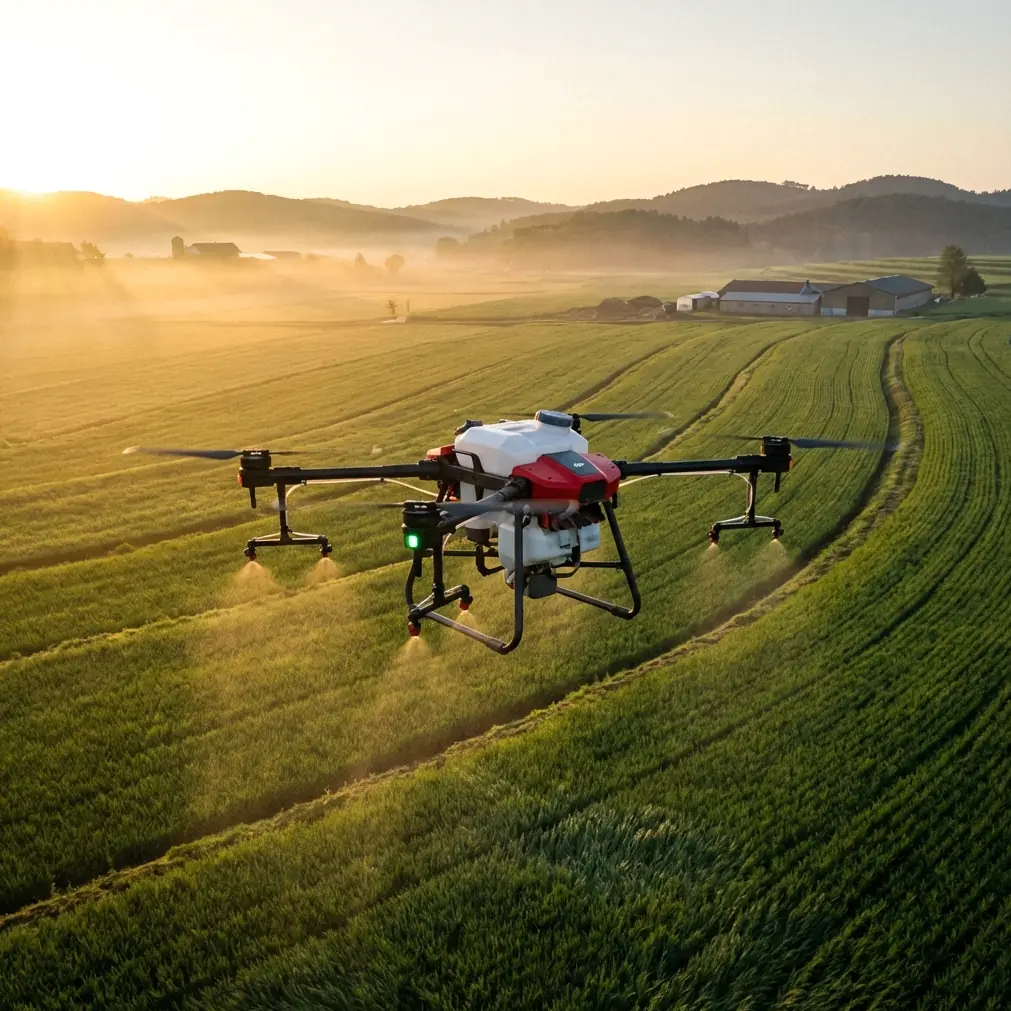
Agras T70P for Urban Field Surveying: What a 1,600-Drone Dubai Order Reveals About Real-World Demand
META: An expert analysis of what the 1,600-unit Dubai Airshow industrial drone order signals for Agras T70P users surveying urban-edge fields, with practical insight on spray drift, pre-flight cleaning, RTK precision, and mission planning.
Urban field surveying sits in an awkward zone. You are often working beside roads, warehouses, substations, canals, greenbelts, clinics, or dense residential edges rather than out in wide-open farmland. That changes everything. Wind behaves differently near buildings. GNSS conditions can degrade around structures. Safety margins tighten. Even routine crop protection planning starts to look more like a precision operations problem than a simple coverage task.
That is why the current industrial drone market matters when evaluating a platform like the Agras T70P. A recent order announced at the 2025 Dubai Airshow offers a useful signal. United Aircraft secured 1,600 heavy-duty industrial drone orders from markets including the UAE and South Korea, spanning low-altitude logistics, medical delivery, and agricultural plant protection. The deal was described as the largest order won by a Chinese company at the Dubai Airshow so far. Those facts are not about the T70P directly, but they reveal something bigger: buyers in difficult operating environments are no longer treating drones as niche tools. They are selecting aircraft as part of integrated, field-ready work systems.
For anyone considering the Agras T70P in urban-adjacent agriculture, that distinction matters.
The real problem in urban field surveying is not coverage. It is control.
Open-field spraying and scouting are often discussed in terms of hectares per hour, tank size, or battery cycles. In urban plots, those metrics still matter, but they are secondary to consistency. The harder question is whether the aircraft can hold a stable line, maintain predictable swath width, and avoid pushing droplets or granules into the wrong place when the landscape starts creating turbulence.
This is where a serious operator thinks beyond headline specs.
A drone used around urban fields must deliver centimeter-level positional discipline, not just “good GPS.” If your RTK fix rate drops near structures, your route fidelity suffers. If route fidelity suffers, overlap increases in some strips and coverage gaps appear in others. In a survey workflow, that weakens data quality. In a spraying workflow, it can create under-application, over-application, or drift risk at the field margin. In a spreading workflow, it can distort input distribution enough to affect crop uniformity later.
The lesson from the Dubai Airshow order is operational confidence. Among the aircraft included in that industrial order was the Q20, reported with a 73-minute endurance, intended for high-precision tasks such as power inspection and logistics delivery. That detail matters because it shows what industrial buyers are rewarding: not novelty, but aircraft that hold up in missions where accuracy and repeatability are non-negotiable. Urban agriculture is not identical to powerline inspection, but the tolerance for error is similarly low when your working area sits next to people, property, or public infrastructure.
For an Agras T70P operator, that means one thing. The mission starts before takeoff.
The overlooked safety step: pre-flight cleaning is not housekeeping
Most operators know to check props, batteries, and route files. Fewer treat cleaning as a precision step. They should.
On urban-edge farms, dust, fertilizer residue, dried chemical film, and road grime accumulate quickly. If you are using the Agras T70P for spray missions after survey flights or moving between plots near traffic corridors, deposits on the frame, radar housings, vision sensors, landing gear, and nozzle assemblies can create small but real performance penalties. A dirty sensor window can reduce obstacle-awareness confidence. Residue near spray components can alter nozzle behavior. A crusted fitting may not fail dramatically, but it can shift atomization quality enough to affect droplet size and spray drift.
That is why I recommend a disciplined pre-flight cleaning sequence as part of the safety protocol, especially for urban field work:
- Inspect and wipe sensor surfaces first, not last.
- Check nozzle tips for partial blockage or uneven wear.
- Verify line integrity and look for dried deposits around joints.
- Clean landing gear and lower body surfaces where chemical residue often accumulates.
- Confirm that any protective housings and seals remain properly seated after cleaning.
This is not cosmetic maintenance. It directly supports operational safety and application consistency.
If your platform is designed with a robust weather-resistant airframe such as an IPX6K-class protection concept, that improves survivability in wet or dirty agricultural environments. But ingress protection is not a substitute for cleaning. Resistance to washdown helps preserve reliability; it does not remove residue-induced measurement errors or nozzle imbalance. In other words, ruggedness gives you margin. Cleanliness protects precision.
Why nozzle calibration matters more in city-edge plots
Nozzle calibration is often treated as a seasonal task. In urban field conditions, that is not enough.
The challenge is simple: the edge rows are where mistakes become visible and potentially consequential. A poor spray pattern in the center of a large rural block might reduce efficacy. The same issue on a plot beside a walkway, drainage channel, or greenhouse can create drift beyond the intended area. The operator then blames wind, when the root cause may have been an uneven flow rate or poor droplet distribution.
The T70P should be approached as a precision application platform, not just a flying tank. That mindset changes calibration behavior. You should validate output consistency before missions involving urban-edge boundaries, irregular field geometries, or variable crop height. If the aircraft supports route repeatability with RTK, that precision only becomes useful when the liquid delivery system is equally disciplined.
This is also where swath width must be handled realistically. Published maximums are planning references, not commandments. In urban plots with building-induced crosswinds or mixed canopy structure, a narrower effective swath is often the better choice. You sacrifice nominal productivity and gain control. That trade is usually worth it.
A technical operator asks three practical questions before every application mission:
- What swath width can I hold without increasing drift risk?
- Are the nozzles producing a consistent pattern across that width?
- Is my route spacing matched to actual field conditions rather than brochure conditions?
That is the difference between a machine that “covers acres” and a machine that delivers agronomic value.
Surveying and spraying are converging into one workflow
The phrase “surveying fields in urban” sounds narrow, but it points to a broader operational shift. The best agricultural drone programs no longer separate scouting, planning, and application into disconnected activities. They combine them.
An urban-edge farm benefits from a drone workflow that can assess surface conditions, identify problem zones, define safe exclusion areas, and execute treatment with tight geospatial repeatability. This is where technologies like multispectral sensing, terrain-aware planning, and centimeter precision become strategically useful rather than academically interesting.
If you use multispectral data to map vigor variation, you can avoid blanket treatment where only a section of the plot requires intervention. That is good agronomy. In urban-adjacent settings, it is also good risk management. Less unnecessary spraying means fewer passes near sensitive boundaries, fewer battery cycles, and fewer opportunities for drift or route deviation.
Here again, the Dubai order is instructive. The same 1,600-unit deal covered sectors as different as medical delivery, low-altitude logistics, and agriculture. That mix tells us industrial buyers increasingly value drone ecosystems that can support high-reliability workflows across task types. Agriculture is becoming part of that broader industrial standard. The T70P should be evaluated through that lens: can it fit into a disciplined data-to-action cycle, not merely complete a spray run?
The RTK question: fix rate is a field issue, not just a mapping issue
Operators sometimes think of RTK primarily as something for survey-grade mapping. In urban agriculture, that is too narrow.
A high RTK fix rate improves line holding, repeat path execution, and edge accuracy. All three matter when operating around narrow strips, subdivided parcels, utility corridors, or fields interrupted by roads and structures. If the fix quality degrades, route geometry may become less reliable exactly where precision matters most.
In practice, that means pre-mission planning should include a positional risk review:
- Identify likely GNSS shadow zones from nearby buildings or infrastructure.
- Check whether takeoff position gives the aircraft a clean initialization environment.
- Confirm base station or correction service stability before mission launch.
- Plan conservative buffer zones on the downwind and structurally complex sides of the field.
That is not overcaution. It is the operational grammar of urban drone work.
A drone can advertise centimeter-level performance, but the field only sees that benefit when the fix is stable and sustained. The result is sharper route fidelity, more accurate overlap, cleaner coverage maps, and better accountability after the mission.
Industrial demand is telling us what farmers should expect from the next generation of ag operations
The significance of the Dubai Airshow order is not just the 1,600 aircraft. It is the sectors attached to that number. When a single manufacturer wins large-scale demand across logistics, medical distribution, and plant protection, the message is clear: customers want aircraft that can move from demonstration to service deployment.
Agricultural buyers should take that seriously.
The old model of agricultural drone selection focused mainly on payload and output. The new model weighs operational resilience, precision repeatability, maintenance practicality, and system integration. The mention of the TD550 coaxial twin-rotor unmanned helicopter in the same order is also revealing. It was highlighted as capable of operating in complex mission scenarios. Different aircraft, yes. Same market logic. Buyers are rewarding platforms designed for difficult environments, not idealized ones.
For the Agras T70P user surveying and treating urban-edge fields, that translates into a practical checklist:
- Can the aircraft maintain stable work near obstacles and fragmented parcels?
- Can the system support accurate repeat missions with dependable RTK behavior?
- Can the operator clean, inspect, and recalibrate quickly enough to keep precision from degrading across multiple plots in a day?
- Can field data, whether RGB or multispectral, be turned into a smarter treatment plan rather than more flying?
These are the questions that define ROI in the field, even if they rarely appear in promotional material.
A better way to think about the Agras T70P
The T70P should not be framed as a generic agricultural drone for “large farms” or “efficient spraying.” That language misses what serious operators need. Its value is clearer when seen as an urban-capable agricultural work platform that succeeds or fails based on process discipline.
If you run it with lazy route assumptions, irregular cleaning, neglected nozzle checks, and no attention to RTK quality, you will get average results and blame the environment. If you treat it as a precision machine, especially in constrained urban-field settings, it becomes much more useful.
That means:
- cleaning before each mission, especially after chemical work,
- calibrating nozzles based on actual field conditions,
- adjusting swath width for turbulence and field geometry,
- monitoring RTK fix quality as an operational variable,
- and using survey data to reduce unnecessary passes.
Those habits are not accessories. They are what turn a capable airframe into a reliable farm tool.
If you want to compare urban-edge mission setups or discuss field-specific spray planning, this direct line is useful: message an experienced drone specialist.
The broader market is moving toward industrial-grade expectations. The 2025 Dubai Airshow order simply made that visible in one sharp number. When 1,600 heavy industrial drones are ordered across sectors where precision and reliability matter, agricultural users should pay attention. The standard is rising. The Agras T70P belongs in that conversation only when it is operated with the same seriousness.
Ready for your own Agras T70P? Contact our team for expert consultation.