
Agras T70P for Mountain Vineyards: A Technical Review
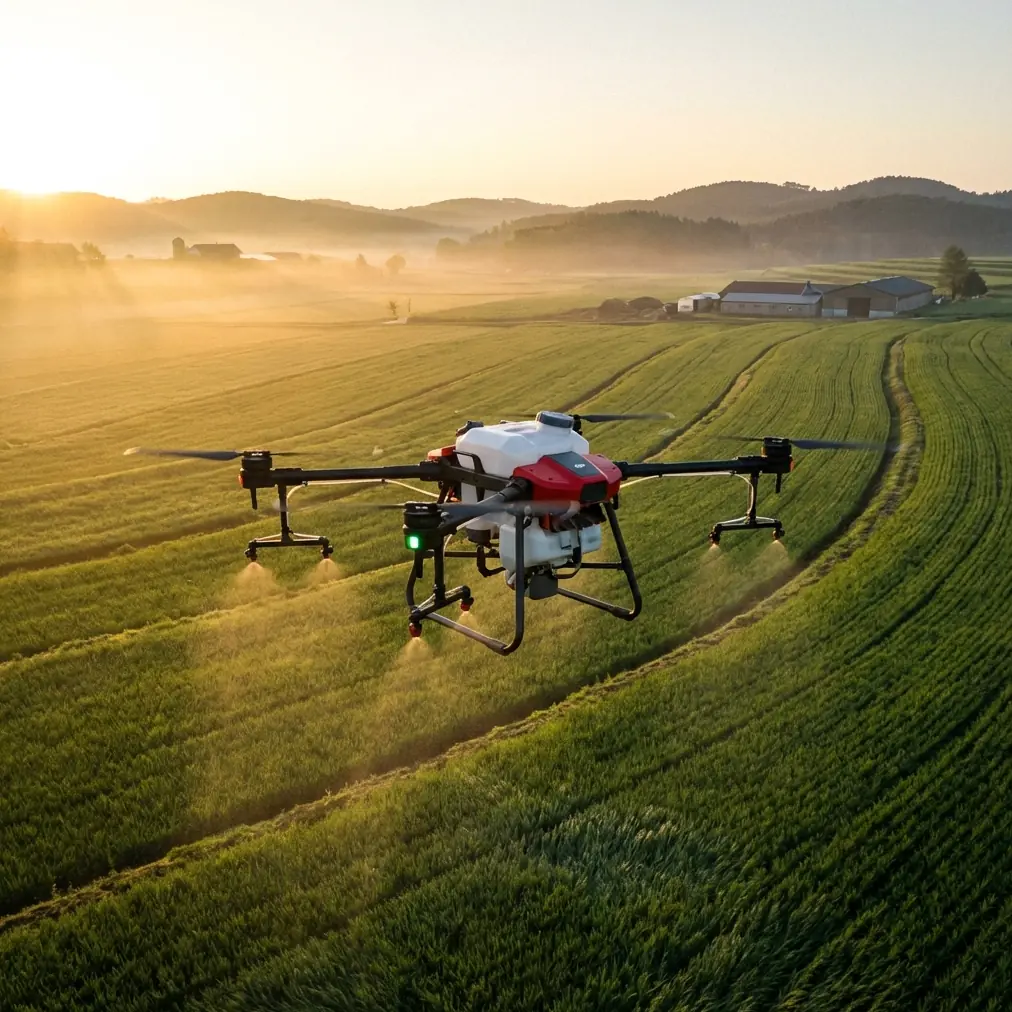
Agras T70P for Mountain Vineyards: A Technical Review of Altitude, Drift Control, and Precision Coverage
META: Technical review of the Agras T70P for mountain vineyard spraying, with practical guidance on flight altitude, spray drift control, RTK stability, nozzle calibration, and terrain-specific operations.
Mountain vineyards punish sloppy spraying. Rows bend with the contour, wind accelerates through gaps, and elevation changes can turn a clean application into drift, runoff, or uneven canopy coverage in a single pass. The Agras T70P enters that environment with a workload few agricultural drones are truly comfortable carrying: precise low-altitude application on broken terrain, where every meter of height and every small error in positioning shows up on the vines.
For growers and operators working steep vineyard blocks, the real question is not whether the T70P is powerful enough. It is whether it can be tuned to spray tightly, consistently, and safely when the ground beneath it is anything but uniform. That is where this aircraft becomes interesting. The T70P is not just a tank-and-motor platform. Its value in mountain viticulture depends on how well its positioning stack, spray system, and environmental protection features hold up under the realities of narrow terraces, irregular row spacing, and fast-changing microclimates.
From an operational standpoint, the most useful way to assess the Agras T70P is through three pressure points: spray drift, nozzle calibration, and terrain-following precision. If those three elements are under control, productivity follows. If they are not, payload size and flight specs matter much less.
Why mountain vineyards expose weaknesses faster
Flat-field spraying gives an operator room to hide mistakes. Mountain vineyards do not. If the drone flies too high above the canopy, droplets spend longer in unstable air and drift sideways before settling where they belong. If the aircraft hugs the canopy too tightly, rotor wash can push spray through the foliage unevenly or create localized overapplication, especially on the exposed shoulder of a slope. Add vineyard geometry—posts, trellis wires, end-row turns, and alternating canopy density—and the margin for error narrows further.
This is why centimeter precision is not a marketing luxury in vineyards. It is an agronomic requirement. A drone that can maintain a strong RTK fix rate while crossing elevation changes has a measurable advantage because row alignment and height consistency directly affect deposition quality. On a mountain block, positional instability shows up as skipped bands on one pass and overlap on the next. That costs chemical, time, and potentially crop safety.
The Agras T70P is particularly relevant here because vineyard work is less about absolute top-end coverage and more about repeatable accuracy on awkward terrain. The machine must hold its line when GNSS conditions are imperfect, maintain a stable swath width despite changing canopy profiles, and deliver a droplet pattern that does not unravel in turbulent hillside airflow.
The optimal flight altitude for this scenario
For mountain vineyard spraying, the most defensible starting point is to target a flight altitude of roughly 2.0 to 3.0 meters above the canopy, then refine within that band based on vine vigor, nozzle setup, and crosswind behavior. In most mountain vineyard conditions, I would begin testing around 2.5 meters above canopy top rather than above ground level.
That distinction matters. On a slope, ground-relative height can be misleading. What determines deposition is the relationship between the spray plume and the vine canopy, not the distance to uneven soil beneath the row. Flying 2.5 meters above canopy gives the T70P enough vertical separation to stabilize the pattern while still keeping droplets close enough to resist lateral displacement. That tends to be the sweet spot when drift risk is present but full canopy penetration is still required.
Move much above 3.0 meters and the exposure time of fine droplets increases, especially on ridge-side rows where wind shear is stronger. In practical terms, that means more material ends up off-target. Drop much below 2.0 meters and the aircraft can become too aggressive in confined row structures, with rotor wash disturbing the spray pattern and creating irregular coverage around dense vine walls. In terraced or tightly stepped plots, very low flight can also reduce reaction time near poles, wires, and abrupt grade changes.
Altitude is not a fixed doctrine, though. If the vines are sparse and recently hedged, the lower end of the range often works better. If canopy density is heavy and the terrain produces unpredictable updrafts, nudging higher can improve consistency. The key is to calibrate altitude with deposition checks, not guesswork. Water-sensitive paper placed on both sides of the canopy is still one of the best ways to confirm whether the chosen height produces even distribution without excessive drift.
Spray drift is the central technical challenge
Among the LSI topics tied to the T70P, spray drift is the one that deserves the most attention in mountain vineyards. Drift is not only a compliance issue. It is a performance issue. A poor drift profile means the aircraft may appear to complete a mission efficiently while the crop receives a weaker or less uniform dose than intended.
The T70P’s usefulness in this setting depends on keeping the droplet cloud compact and predictable. That starts with height, but it does not end there. Operators need disciplined nozzle calibration and realistic swath width expectations. In hillside blocks, the temptation is often to preserve speed and width to maximize hourly output. That is where quality quietly degrades. A swath that looks acceptable in a broad acre field may be too optimistic in a vineyard with variable row angles and exposed edges.
This is why nozzle calibration carries real operational significance. The goal is not simply to confirm flow rate. It is to match droplet spectrum and output to terrain-induced airflow. In mountain vineyards, a nozzle setup that produces excessive fines can create elegant-looking spray clouds that perform badly once side gusts and rotor interaction are introduced. Calibration should therefore be treated as part of drift management, not as a one-time maintenance ritual.
The practical sequence is straightforward: confirm actual output, verify pressure and droplet behavior, then test under site conditions. If drift appears at the row shoulder or deposition weakens on the lee side of the canopy, adjust the setup before increasing mission scale. Too many operators reverse that order.
RTK fix rate matters more on slopes than many realize
A reliable RTK fix rate is often discussed in terms of mapping accuracy, but in spraying it has an immediate agronomic consequence. In a mountain vineyard, the aircraft is constantly resolving position against terrain, row curvature, and canopy boundaries. If the fix becomes unstable, the drone may still fly, but the consistency of the application can deteriorate. The result is not always dramatic. Often it is subtle: a slightly widened overlap zone, a small underdosed section near a contour break, a turn that begins a touch early. Across a block, those small errors accumulate.
That is why centimeter precision has operational significance beyond neat route visualization. It supports tighter pass-to-pass alignment and helps preserve the intended swath width in a setting where the ground track is rarely simple. For growers spraying fungicides or foliar nutrients in vineyards, that consistency can influence both efficacy and residue distribution.
The T70P is best evaluated here not by a brochure claim, but by how well it maintains route fidelity under real obstruction. Trellis structures, nearby tree lines, valley walls, and shifting sky visibility can all interfere with signal quality. When planning missions in mountain vineyards, operators should pay close attention to where RTK stability weakens, because those are the sections most likely to need slower speeds, adjusted headings, or even revised route segmentation.
IPX6K is not a side note
One detail that deserves more respect in agricultural drone operations is environmental sealing. The T70P’s IPX6K rating is especially relevant for vineyard work because spray operations in steep blocks are messy. The aircraft deals with fine droplets, chemical exposure, dust from access roads, and repeated washdown cycles. On mountain sites, it also faces quick weather changes, including mist and light precipitation that can arrive with little warning.
An IPX6K-protected platform is not a license for careless handling, but it does matter operationally. It supports more robust day-to-day field use, reduces vulnerability during cleaning, and gives the operator more confidence when the environment becomes less predictable. In high-frequency vineyard applications, durability is not an abstract engineering virtue. It affects uptime. Uptime affects treatment timing. And timing in disease-prone vineyards can be the difference between proactive control and chasing a problem after it has already spread.
What about multispectral workflows?
The T70P itself is not defined by multispectral sensing, but the vineyard workflow increasingly is. In mountain viticulture, multispectral data can be valuable for distinguishing vigor zones, identifying stress patterns, and prioritizing treatment intensity across irregular blocks. When paired with a spray platform like the T70P, that matters because it shifts the operation from blanket application toward more informed intervention.
The operational significance is straightforward. A multispectral survey can reveal where canopy density, water stress, or disease pressure differs across elevation bands. That information helps operators choose more sensible mission parameters, including speed, flight altitude tolerance, and application focus. In a mountain vineyard, one section may justify slower passes and tighter canopy targeting, while another can be treated more efficiently without sacrificing deposition quality.
The drone does not become smarter by magic. The operator becomes smarter by integrating better field intelligence.
Swath width: the number that should make you cautious
If there is one setting vineyard operators should treat conservatively, it is swath width. Broad swaths are attractive on paper because they promise faster completion. On slopes, they can become a source of inconsistency. Canopy height, row spacing, and side wind all distort what a “clean” swath really means.
For the T70P in mountain vineyards, a slightly narrower effective swath often produces better real-world results than an aggressive maximum-width plan. That is because overlap is not always waste. In difficult topography, controlled overlap is sometimes what preserves uniform coverage when the environment refuses to behave like a flat test field.
Operators who want stronger outcomes usually gain more from disciplined swath reduction than from pushing speed. A modestly slower mission with stable deposition beats a fast mission that looks efficient in logs but leaves the crop unevenly protected.
A practical operating mindset for the Agras T70P in vineyards
The best T70P results in mountain vineyards come from pilots who think like agronomists. Start with canopy geometry, not machine capability. Establish flight altitude relative to the vine top, not the slope beneath. Verify nozzle calibration with the day’s conditions in mind. Watch RTK behavior where terrain blocks the sky. Be conservative with swath width. Use deposition checks to validate assumptions.
That approach is less glamorous than quoting maximum capacity, but it is what separates precise application from expensive noise. If you need a second opinion on route planning or canopy-specific setup, you can send your vineyard parameters through this quick field support link: message a UAV specialist.
The Agras T70P can be a very capable vineyard tool, particularly where ground rigs struggle with access and slope. But in mountain blocks, capability only translates into agronomic value when the aircraft is flown within the logic of the terrain. The machine’s strengths—centimeter-level positioning discipline, durable field-ready construction with IPX6K protection, and a spray system that rewards careful calibration—become meaningful only when matched with operator restraint and measurement.
For most mountain vineyard operators, the single best starting insight is simple: begin around 2.5 meters above canopy, not above ground, and tune from there with deposition evidence. That one decision influences drift, canopy penetration, and route stability more than many realize. In steep vineyards, good spraying is rarely about flying harder. It is about flying precisely enough that every liter lands where the vines can actually use it.
Ready for your own Agras T70P? Contact our team for expert consultation.