
Agras T70P Spraying Tips for Dusty Solar Farms
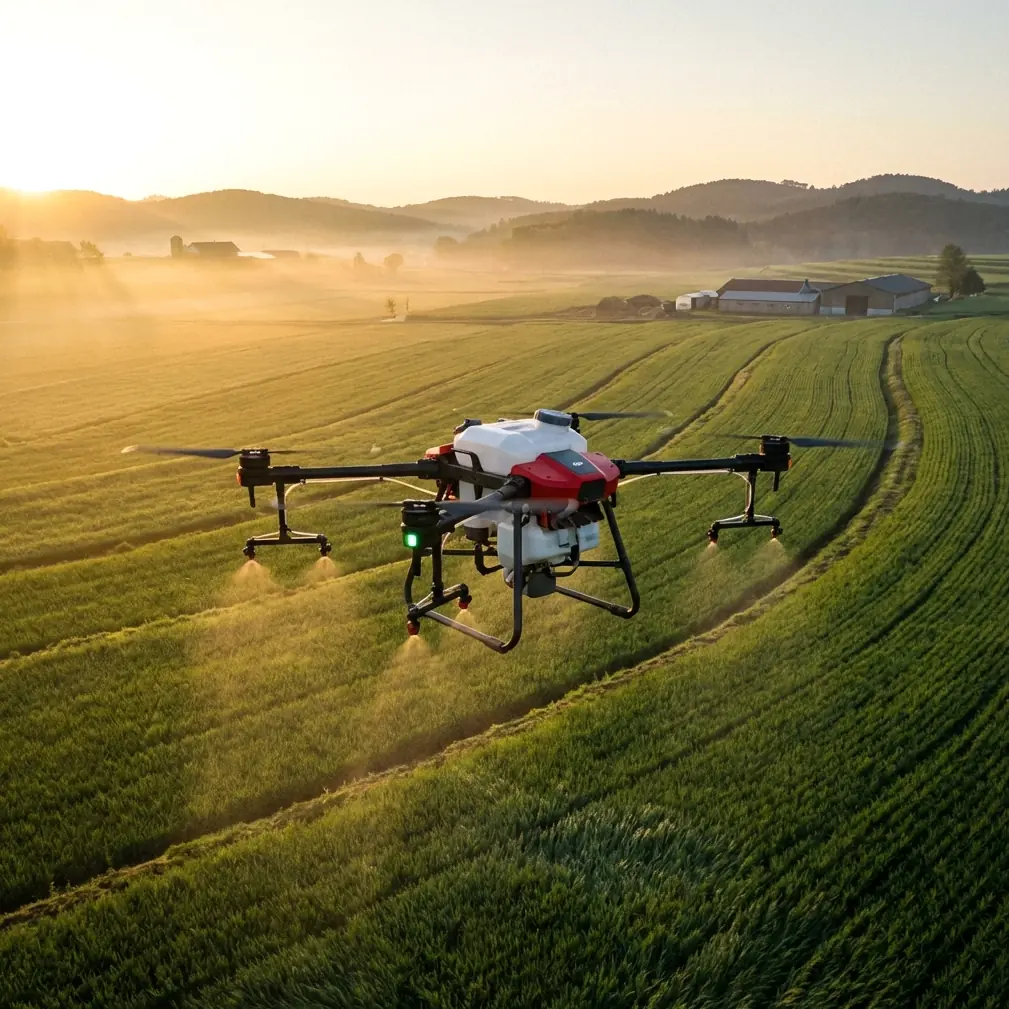
Agras T70P Spraying Tips for Dusty Solar Farms: What Actually Matters in the Field
META: Practical Agras T70P spraying guidance for dusty solar farm operations, with a focus on return-to-home logic, route planning, RTK workflow, drift control, and data precision.
Dusty solar farms are harder on spray operations than many operators expect. Panels sit in long repeating rows, access roads throw fine particulate into the air, and line-of-sight can disappear fast once the aircraft moves deeper into the site. If you are evaluating the Agras T70P for this kind of work, the real question is not whether it can carry liquid and fly a route. The question is whether your operating method is robust when visibility drops, GPS quality shifts, and precision starts to matter more than raw acreage per hour.
That is where the conversation gets more interesting.
A lot of drone discussions get stuck on surface-level performance claims. In actual dusty solar farm work, the stronger differentiator is system behavior under imperfect conditions: how the aircraft returns when communication fails, how the route is built to avoid compounding error, how nozzle calibration is maintained when dust is constantly working against consistency, and how navigation data is processed so your coverage remains dependable over long corridors.
The reference material behind this article was not written specifically for the T70P. That is useful, not limiting. It points to principles that remain operationally relevant across serious UAV workflows: safe automatic return during beyond-visual-line-style conditions, route-following logic in narrow linear environments, and fused positioning workflows that improve location and attitude accuracy. Those three ideas map unusually well to solar farm spraying.
Why dusty solar farms punish weak workflow design
Solar sites are visually simple from the ground and operationally tricky from the air. Rows are repetitive. Turnarounds can be tight. Dust clouds kicked up by service vehicles can reduce contrast and obscure obstacles. Even if the T70P’s onboard systems are capable, bad route design or lazy spray setup can still produce missed strips, overapplication along row edges, and unnecessary drift onto panel surfaces or nearby maintenance corridors.
The most common failure in these sites is not dramatic. It is cumulative. A small navigation inconsistency on each pass becomes a visible coverage pattern by the end of the day. A slight nozzle mismatch becomes uneven wetting across a swath. A poor return strategy turns a manageable interruption into a recovery problem.
That is why I would treat the T70P less like a simple agricultural sprayer and more like a corridor-work platform. The references support that mindset.
The first non-negotiable: understand return-to-home behavior before you spray
One of the most practical details in the source material comes from a training document on UAV return logic. It explains that drones are often operating in conditions where the ground operator has only a limited forward camera view, and that the aircraft may have to decide to return automatically if communication is lost, battery drops, or weather conditions degrade. It also describes a simple but critical mechanism: the ground station periodically sends a message, and if the aircraft does not receive that message within a specified time, it is treated as a loss-of-link event and the return routine begins.
That matters on a solar farm because dust can create situational ambiguity even when the aircraft itself is stable. The operator may still have telemetry, but degraded visual clarity can make it harder to interpret what is happening near panel rows, service poles, fences, and inverter pads. If your T70P operation includes stretches where the aircraft is effectively working beyond useful visual detail, your return behavior is not a backup topic. It is central to mission design.
The same training reference describes two return concepts: retracing the original route, or climbing to a preset return altitude before navigating by GPS coordinates back to the takeoff point. For dusty solar sites, each has a place.
- Original-route return is often safer when the outbound route already threads a narrow and obstacle-aware corridor.
- Climb-then-return logic may be cleaner where row spacing is regular and vertical clearance is better understood than lateral obstruction risk.
The significance is operational, not academic. On a site with repeating metal structures, cable runs, and occasional maintenance equipment, choosing the wrong return profile can turn a predictable auto-recovery into a path conflict. Before the first spray mission, operators should verify which return mode best matches the site geometry and whether the selected return altitude truly clears all local infrastructure, not just the panels themselves.
Think of solar farm spraying as a linear inspection problem with liquid onboard
A second reference comes from a lidar powerline project in Guangdong that covered 300 kilometers with an 80-meter corridor width. Different mission, same lesson: long, narrow operating environments demand disciplined route planning, data handling, and trajectory control.
The document highlights that flight parameter design should be based on effective range, flight altitude, and speed, and then used to calculate line-scan speed and route spacing. Replace lidar line spacing with spray swath width and the principle still holds. T70P spraying on a solar farm should never begin with “let’s see how wide it looks today.” Your route spacing must be tied to:
- actual nozzle output,
- target droplet behavior in dusty air,
- expected crosswind,
- flight speed,
- release height above the target zone.
This is where spray drift and nozzle calibration stop being side notes. Dust often coincides with dry, warm, moving air. That environment can carry fine droplets farther than expected, especially along open service lanes between panel arrays. If your swath width assumption is too optimistic, you will get underlap in the center and contamination at the margins.
A disciplined operator measures output, verifies nozzle health, and then builds route spacing from real performance rather than brochure assumptions.
Nozzle calibration on the T70P: do it more often than you think
Dust does not just affect visibility. It attacks repeatability.
Fine particulate can accumulate around nozzle assemblies, affect atomization quality, and alter what would otherwise be a stable flow pattern. On a site where every pass should look essentially identical, even slight asymmetry between left and right output becomes costly. You may not notice it immediately from the ground, but by the time the pattern becomes visible on the treated surface, the rework burden has already begun.
A practical T70P discipline for dusty solar farms looks like this:
- confirm nozzle output before the mission,
- inspect for partial obstruction during refills,
- re-check pattern quality after any visible dust plume event,
- reduce assumptions about “set and forget” consistency.
This is especially relevant if you are using a third-party accessory such as an upgraded inline filtration kit or anti-drip nozzle assembly to stabilize spray quality in dirty conditions. A good accessory can absolutely improve field performance, but it does not remove the need for calibration. It simply gives your calibration a better starting point.
I have seen operators benefit from third-party filtration setups that reduce particulate intrusion during transfer and tank refill cycles. That kind of enhancement is not glamorous, but it can preserve nozzle behavior over a longer workday. On dusty utility sites, that is real capability, not a cosmetic add-on.
RTK Fix rate and trajectory quality are more important than many spray teams admit
The lidar reference also points to a mature data workflow: GNSS and IMU are fused to create a precise trajectory file, and software such as Inertial Explorer supports compatibility with major GNSS base station formats including NovAtel, Trimble, JAVAD, Leica, NAVCOM, and Septentrio. That is a mapping-grade context, but the underlying principle matters for the T70P too.
If your drone depends on centimeter precision for repeatable path tracking, then RTK Fix rate is not just a technical metric tucked away in the interface. It directly affects pass-to-pass consistency. On solar farms, where rows create a highly repetitive visual scene, stable high-quality positioning reduces the chance of gradual lateral creep over multiple legs.
Even if your spraying workflow does not require the full post-processed rigor of a lidar corridor survey, you should adopt the same mindset:
- validate base station setup,
- monitor RTK status rather than assuming it is stable,
- watch for transitions between fixed and float solutions,
- avoid launching large corridor sections when correction quality is inconsistent.
The source document’s emphasis on fusing position and attitude data is also a reminder that aircraft orientation matters, not just latitude and longitude. In dusty crosswinds, attitude changes can subtly affect actual droplet placement. If the T70P is constantly compensating in roll or yaw, your nominal route may still produce a less-than-nominal application footprint.
Build missions with interruption in mind
One of the most useful details from the educational UAV reference is its example of a narrow river patrol route broken into segments, with the aircraft returning automatically along the planned route after a trigger event. It even includes specific turn values such as 70 degrees, 65 degrees, and 75 degrees in a curved path simulation. The exact angles are not the point for solar work. The lesson is that segmented route logic is safer and easier to recover than improvisational flying.
Solar farms benefit from the same design logic.
Instead of planning one huge spray block, divide the job into route sections that match the physical rhythm of the site: panel groups, aisle runs, inverter zones, perimeter strips. When the aircraft must pause due to dust, battery, vehicle movement, or a temporary access conflict, recovery becomes much cleaner. You know exactly where the interruption occurred and how to resume without overlap chaos.
This is one of those practices that looks conservative on paper and efficient in reality.
A note on visual judgment: why “field aesthetics” still matter
One of the supplied news items is not about drones at all. It is about photography, published on 2026-05-19, and it argues that technical settings are not the heart of strong images; accumulated judgment is. In that context, the author says quality comes from the eye behind the lens rather than from filters or parameter tweaking alone.
That idea transfers surprisingly well to T70P operations on solar farms.
A skilled operator does not rely only on settings and automation. They develop judgment. They learn what dust density looks like before it starts affecting application quality. They recognize when panel-row geometry is likely to distort depth perception on the screen. They notice the subtle signs that a swath is not landing evenly. Like photographic taste, that operational judgment is built through repeated observation.
For ordinary photographers, the article says the goal is often to record life and express intent. For solar farm spray crews, the equivalent is to complete a mission cleanly, safely, and consistently. Technique is essential. Judgment decides whether the technique is being applied at the right moment.
A practical T70P setup checklist for dusty solar farms
Here is the workflow I recommend operators standardize:
1. Confirm route logic before chemical loading
Test route shape, return behavior, and failsafe assumptions with a dry run. Decide whether original-path return or climb-then-return is the safer profile for the site.
2. Verify RTK stability at the start and during the mission
Do not just glance at a green indicator. Track Fix quality and be cautious if conditions suggest intermittent correction performance.
3. Calibrate nozzles with the day’s real conditions in mind
Dust, temperature, and target surface geometry all affect the practical swath. Re-check if there is any sign of contamination or uneven output.
4. Reduce drift proactively
Adjust speed, release height, and route spacing when dusty air and crosswind begin to move droplets unpredictably. A slightly narrower effective swath with cleaner placement is usually the better trade.
5. Segment the mission
Treat the farm like a corridor project, not an open field. This simplifies interruption recovery and improves coverage accountability.
6. Watch the aircraft’s attitude, not just its path line
Repeated compensation for wind or turbulence can change how the spray reaches the target area even when navigation appears on track.
7. Improve the support system around the aircraft
A well-chosen third-party filtration or transfer accessory can reduce contamination pressure on the spray system. If you need help comparing field-proven options, you can message a specialist here.
Where the Agras T70P fits best
The T70P makes sense on solar farm work when the operator treats it as a precision application tool inside a constrained industrial environment. That means bringing agriculture discipline together with corridor-survey discipline. The references support exactly that blended approach.
From the UAV training document, the key takeaway is that limited visual context and loss-of-link scenarios require deliberate auto-return planning. From the lidar corridor project, the lesson is that long, narrow work zones reward careful route spacing, trajectory quality, and integrated control workflows. From the photography article, oddly enough, comes the human factor: strong results depend on judgment built through repetition, not on settings alone.
That is the practical center of T70P solar farm spraying in dusty conditions. Not hype. Not generic drone talk. Just disciplined operations, precise route design, and enough field awareness to know when the environment is starting to push the system off its ideal line.
Ready for your own Agras T70P? Contact our team for expert consultation.