
Agras T70P Field Report: Best Practices for Spraying Solar
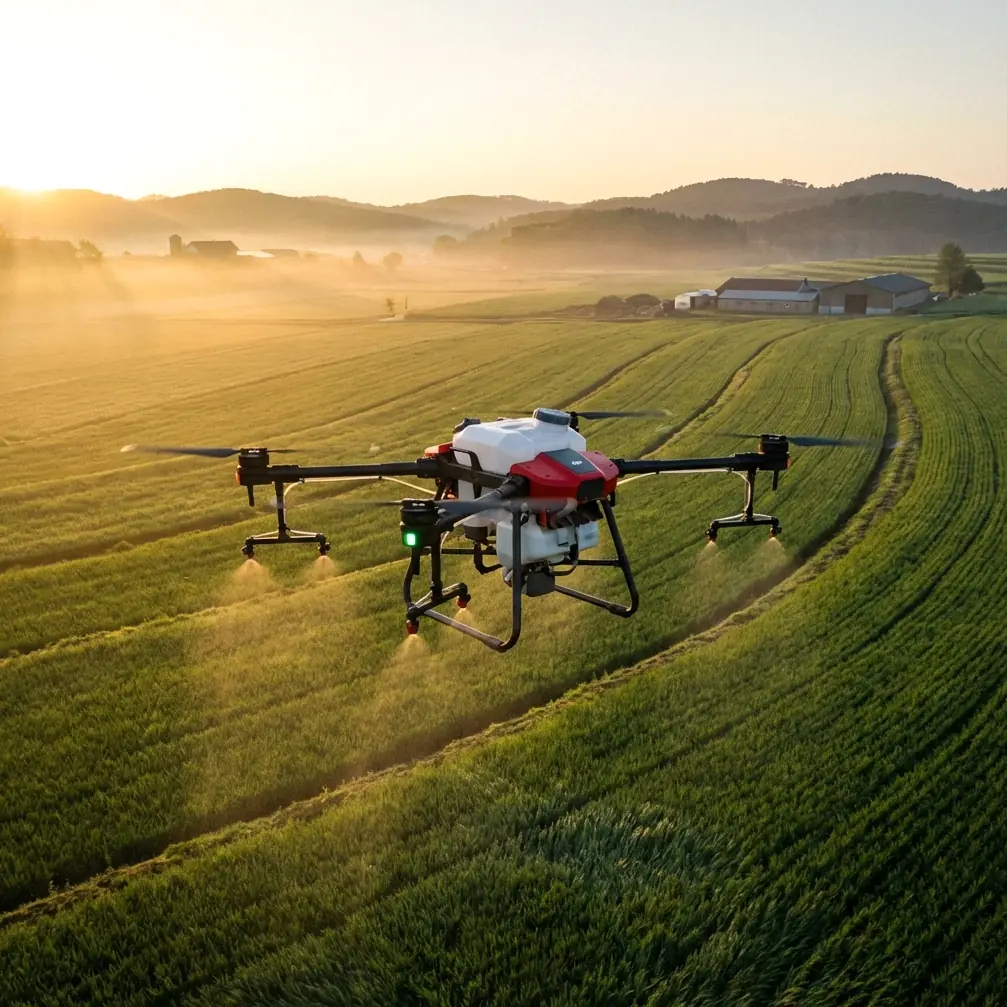
Agras T70P Field Report: Best Practices for Spraying Solar Farms in Mountain Terrain
META: Expert field report on using the Agras T70P for mountain solar farm spraying, with practical guidance on spray drift, nozzle calibration, RTK fix rate, swath width, centimeter precision, and all-weather operations.
Mountain solar sites create a peculiar kind of workload. They are engineered environments dropped into uneven ground, with tight service roads, shifting wind corridors, panel rows that amplify turbulence, and vegetation that never seems to grow evenly. For operators considering the Agras T70P for this kind of mission, the real question is not whether a large agricultural drone can spray a solar farm. It can. The harder question is how to make it spray accurately, safely, and repeatably when slope, reflectivity, and microclimate all work against consistency.
This field report is written from that exact scenario: spraying vegetation around a mountain solar installation where terrain changes quickly, access is limited, and drift control matters as much as coverage. The Agras T70P is often discussed in broad terms, but broad claims are not useful on a hillside with narrow maintenance lanes and panel arrays that turn gusts into sudden sidewash. What matters is operational discipline.
The first thing to understand is that mountain solar farms are not ordinary crop blocks. In row crops, the canopy often provides a visual and aerodynamic logic. Solar fields do not. You are dealing with alternating hard surfaces and vegetation strips, irregular drainage patterns, gravel shoulders, fence lines, inverter pads, and abrupt elevation transitions. That means the T70P’s value comes less from raw payload thinking and more from how well it can hold an intended line, maintain a stable spray envelope, and recover from environmental disturbances without creating skips, over-application, or drift onto hardware.
That is where centimeter precision and RTK behavior become operational issues rather than specification-sheet trivia. In mountain work, a drone that simply “flies accurately” is not enough. The practical benchmark is whether it can maintain a strong RTK fix rate across reflective surfaces, partial obstructions, and slope transitions where the geometry of signal reception changes from one pass to the next. Solar panels can create a visually orderly environment, but radio and positioning conditions are not always orderly. If your fix quality degrades during lateral transitions between terraces or near service structures, swath alignment starts to suffer. Small deviations become expensive because they compound row after row.
With the T70P, maintaining consistent path repeatability is especially important when the treatment zone runs close to panel edges, cable trays, and drainage channels. A few centimeters of lateral inconsistency may not matter in broadacre spraying. On a solar farm, it can mean one strip of persistent regrowth beside a support post and excess deposition on gravel in the next lane. Good operators watch RTK status continuously, not passively. If the fix rate dips in a known problem zone, the answer is rarely to press on and hope the map smooths it out. The better practice is to mark that segment, adjust the route geometry, and rerun with a more conservative swath plan.
Swath width deserves more attention than it usually gets. On flat, open land, operators are often tempted to maximize width for throughput. In mountain solar sites, that instinct can backfire. Wider is not always more efficient if it forces the aircraft to spray across unstable crosswinds or over uneven vegetation height that changes droplet interception. A narrower, better-controlled swath can outperform an aggressive pattern because it reduces edge uncertainty and helps keep the spray cloud where it belongs. The T70P is capable of high-output work, but output only matters when deposition is uniform enough to solve the vegetation problem without introducing a hardware contamination problem.
Nozzle calibration is the discipline that separates acceptable work from trustworthy work. In mountain conditions, a slight mismatch between intended flow and actual flow does more than alter application rate. It changes droplet behavior in a location where wind and slope are already distorting trajectories. Calibration should not be treated as a one-time checklist item at the truck. It needs to be verified against the day’s formulation, expected flight speed, target vegetation density, and the specific spacing of the treatment lanes. If one bank of nozzles is underperforming, the error pattern may not be obvious from the air. You will see it later as uneven suppression along the downhill side of a row, where turbulence already challenges deposition.
Spray drift is the dominant risk in this environment, not just from a compliance standpoint but from an asset-management perspective. Drift onto panel surfaces is not merely untidy. It can complicate maintenance, create residue concerns, and trigger unnecessary troubleshooting when site staff notice spotting or film on glass. The mountain setting worsens this because wind rarely behaves as the forecast suggests. Airflow bends around ridges, accelerates through gaps, and changes character near the panel face. A calm launch point can conceal active lateral drift one terrace higher.
The T70P’s operational advantage in these conditions depends on restraint. Lower boom height relative to target, disciplined speed management, and an intentionally conservative droplet strategy are usually worth more than trying to finish the whole block in one uninterrupted rhythm. Mountain solar work rewards segmented planning. Divide the site by exposure, elevation, and wind behavior, then match the mission to those segments rather than treating the farm as a single map.
One memorable example from a recent mountain inspection illustrates why sensor awareness matters even on routine vegetation control. At first light, a roe deer moved out from the brush line and crossed between two panel rows just as the aircraft was approaching a programmed pass. The obstacle sensing system detected the movement quickly enough for the operator to halt the approach and reposition without forcing a chaotic manual correction. That moment was brief, but it captured the difference between a drone that merely follows a route and one that supports safe real-world operations in mixed-use landscapes. Mountain solar farms are not sterile industrial boxes. They sit inside living terrain. Wildlife encounters are normal, not exceptional.
This also hints at a larger operational truth: sensor performance is not just about avoiding poles and wires. It helps preserve application quality. A smooth deceleration and reroute around an unexpected obstacle is far better than a last-second manual evasive input that causes yaw instability, height variation, and an uncontrolled spray edge. On a site where precision matters, flight stability and spray integrity are inseparable.
Weather resistance is another factor operators tend to underestimate until they work a mountain site through a variable season. An IPX6K-rated platform matters here because these jobs often involve damp mornings, road spray, residue accumulation, and repeated cleaning cycles after work around dust and vegetation debris. In mountain solar operations, the aircraft is exposed to a mix of moisture, grit, and chemical residue in ways that can punish weaker field equipment. A robust ingress protection rating does not make planning optional, but it does support the kind of repeated deployment schedule that real contractors need. If the platform has to be cleaned thoroughly after a muddy roadside loadout or after a misty predawn shift, that durability becomes practical, not abstract.
There is also a place for multispectral thinking in this workflow, even if the T70P itself is not defined by multispectral payload use in the way a dedicated mapping aircraft might be. On large mountain solar sites, multispectral data collected as part of a broader operation can help identify differential vegetation vigor, moisture retention patterns, and recurring regrowth zones along drainage lines or panel shadow bands. That matters because not every strip around a solar array needs the same treatment intensity. Pairing T70P spraying missions with upstream vegetation intelligence can reduce unnecessary application and improve timing. This is especially useful where access roads make repeated ground scouting inefficient.
For operators building a repeatable mountain-solar program around the T70P, I recommend five field principles.
First, treat RTK reliability as a live performance metric. Do not assume that a locked solution at takeoff guarantees stable centimeter precision across the site. Watch for repeat problem corridors and redesign routes around them.
Second, reduce swath width before conditions force you to. If you see gusting sideflow, uneven target height, or turbulence near panel edges, a narrower pattern preserves quality. Throughput lost on paper is often recovered by avoiding rework.
Third, calibrate nozzles to the site, not just to the machine. Formulation, speed, lane geometry, and elevation shifts all influence real deposition. Rechecking flow balance can prevent a full day of uneven results.
Fourth, manage drift as if every panel row were a sensitive boundary. That mindset produces better decisions on timing, height, and route sequencing.
Fifth, use obstacle sensing as part of application quality control, not just collision prevention. Wildlife, maintenance carts, stray tools, and temporary site activity can all disturb an otherwise clean run.
The Agras T70P makes sense for mountain solar vegetation management when operators respect the environment it is flying in. This is not a brute-force spraying problem. It is a precision fieldcraft problem with industrial consequences. The drone’s practical strengths show up when the crew understands topography, keeps calibration tight, monitors fix quality, and accepts that a measured operating tempo often produces better overall productivity than an aggressive one.
If you are planning a mountain solar workflow and want to compare route design or drift-control setup with another experienced team, you can start that conversation here: message our field specialists. In my experience, these missions are won before takeoff, during the planning choices that determine whether the aircraft spends the day correcting instability or executing clean, boring, repeatable passes.
That is ultimately the standard the T70P should be judged against in this setting. Not theoretical capacity. Not headline output. The real benchmark is whether it can deliver consistent vegetation control around sensitive infrastructure on steep, wind-affected ground with minimal drift, stable line holding, and enough resilience to keep working through the realities of mountain field operations. When configured and flown with that standard in mind, it becomes a highly credible tool for one of the more demanding low-altitude spraying jobs in the UAV sector.
Ready for your own Agras T70P? Contact our team for expert consultation.