
Agras T70P for Complex-Terrain Site Spraying
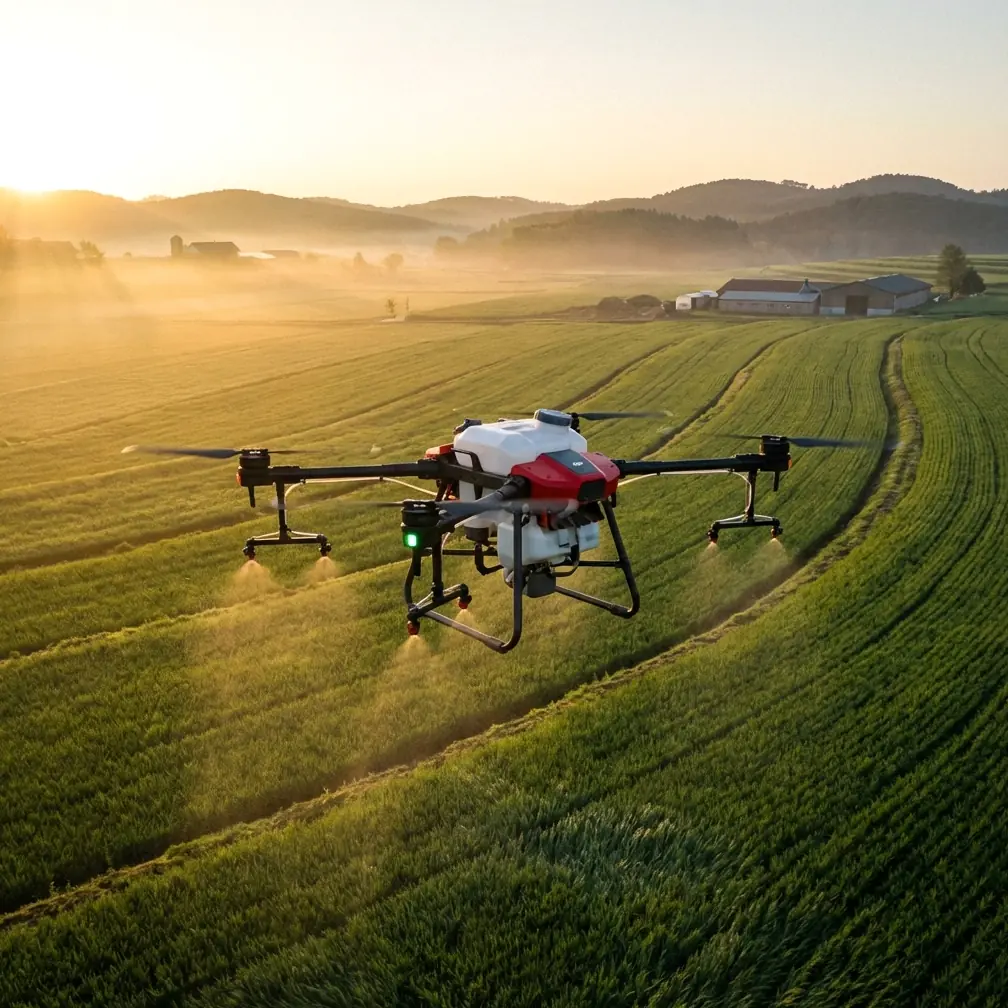
Agras T70P for Complex-Terrain Site Spraying: What Actually Matters in the Field
META: A technical review of the Agras T70P for spraying construction sites in complex terrain, with practical insight on precision flight logic, safety broadcast trust, drift control, and workflow reliability.
I’ve spent enough time around difficult spray environments to know that the hard part is rarely the tank, the pump, or the headline spec. The hard part is consistency when the site itself refuses to behave.
Construction corridors cut into hillsides. Retention basins with abrupt grade changes. Temporary roads that throw dust into the air one hour and channel wind the next. Uneven pads, rebar stacks, utility obstacles, and narrow access windows. If you are looking at the Agras T70P for this kind of work, the real question is not whether it can spray. The question is whether it can spray predictably when the terrain, the airspace picture, and the mission geometry all get messy at once.
That is where this aircraft becomes interesting.
Why complex terrain changes the buying decision
Flat, open agricultural blocks forgive a lot. Construction sites do not. On a site with elevation shifts and fragmented treatment zones, you are constantly balancing three things:
- placement accuracy
- drift control
- pilot confidence in the aircraft’s position and awareness inputs
Those three are tied together more tightly than many buyers realize.
If the aircraft cannot hold a dependable positional solution, your swath width planning becomes theoretical. If your route logic is clumsy, nozzle calibration becomes less meaningful because your overlap pattern starts changing at corners, edges, and elevation transitions. And if the pilot does not trust the aircraft’s safety and visibility layer, every decision becomes slower and more conservative.
That last point deserves more attention than it gets.
A recent aviation debate outside the spray-drone market touched a nerve that matters here too: AOPA publicly backed comments from FAA Administrator Bryan Bedford opposing charges for ADS-B broadcasts, and the broader concern was simple—once pilots stop trusting safety-related broadcasts, the whole idea of universal conspicuity weakens for both crewed and uncrewed aviation. That may sound distant from a construction spray mission, but it is not. On mixed-use airspace near work zones, utility corridors, or semi-rural development sites, trust in the visibility layer is not an abstract policy issue. It directly shapes how confidently operators launch, reposition, and manage risk.
For an Agras T70P operator, that means the machine’s value is not just in payload handling or throughput. It is in how well the aircraft fits into a workflow where situational awareness has to be believable.
The T70P makes more sense when you think in coordinates, not just routes
One of the best training references I’ve seen for explaining autonomous drone movement is not from heavy industrial spraying at all. It comes from an educational drone text that uses a simple exercise: start at one point, fly forward 60 units, then move right 80 units, and finally return to the start without changing the aircraft’s heading. The purpose is to teach the difference between basic movement commands and coordinate-based flight logic.
That sounds elementary until you put it next to a construction spray job.
On a difficult site, basic “go there, then turn, then come back” thinking falls apart fast. What matters is whether the aircraft can execute movement relative to a coordinate frame rather than relying on simplistic directional assumptions. The educational example also explains the practical leap from 2D coordinates like (3,5) to 3D positions like (5,6,8). Again, that is not just classroom material. It is the right mental model for complex-terrain spraying.
Why? Because site spraying is not a flat map problem.
You are not merely tracing polygons. You are managing position in three dimensions while trying to preserve application quality. On a stepped or sloped site, the spray result depends on how well the aircraft tracks spatial intent, not just ground path. That is why I pay close attention to RTK fix rate and centimeter precision claims in this class of aircraft. When an operator says a drone “flies nicely,” what they often mean is that the machine holds a stable relationship to the treatment surface and the planned corridor.
That matters for two reasons:
- Swath consistency. If terrain or position drift keeps nudging the aircraft off its intended line, your overlap changes pass to pass.
- Nozzle effectiveness. Calibration only means something if the aircraft actually flies the spacing and speed profile the calibration assumes.
The T70P’s appeal on complex terrain is that it fits a coordinate-first workflow better than the old “eyeball and correct” style that many crews were forced to use with earlier systems.
My own turning point with terrain spraying
A few seasons ago, I was asked to review a site treatment plan on a steep mixed-use development area. Nothing exotic. Just the kind of job that wears crews down because every zone has a different problem. One terrace needed edge treatment near retaining walls. Another section had standing dust that complicated visual judgment. The lower basin was sheltered enough that the wind profile near the ground barely matched what the pilot felt at takeoff.
The equipment on hand could technically do the job, but every pass involved too much manual compensation. The pilot was constantly correcting for geometry, changing visual references, and second-guessing how the aircraft was sitting over the grade. The result was slow work and inconsistent confidence.
What would have made that day easier was not a flashier airframe. It was a platform built around repeatable spatial control, robust environmental tolerance, and a better operational rhythm. That is the lane where the Agras T70P belongs.
This is also why details like IPX6K matter more than they seem to on paper. Complex construction sites are hard on equipment. Spray residue, mud, dust, washdown cycles, and transport grime all accumulate. A machine used in this segment must tolerate the reality that it will not live a sheltered life. Rugged sealing is not glamour; it is uptime.
Spray drift is where the T70P either earns respect or gets exposed
Most readers looking at the T70P for construction applications are probably focused on coverage speed. Fair enough. But speed is secondary if drift control is poor.
Construction sites amplify drift problems because the environment is broken up. You have walls, berms, stockpiles, cut slopes, and partial enclosures creating localized airflow changes. In those conditions, a drone that looks efficient on an open run can become unpredictable at the edges.
A serious T70P setup therefore starts with discipline:
- define target height against the actual treatment surface, not a rough site average
- match droplet strategy to the site’s dust, wind shear, and nearby sensitive surfaces
- verify nozzle calibration against the intended speed and spacing, not a generic baseline
- adjust swath width to what the site can realistically support, rather than what a brochure suggests
The T70P becomes valuable here because a stable high-precision positioning workflow supports these adjustments. If the aircraft can repeatedly hit the same line with centimeter precision, then swath width tuning becomes a real optimization tool instead of guesswork. If RTK fix rate remains strong through the operation, drift mitigation planning stays connected to actual aircraft behavior.
That connection is everything.
I’ve seen crews obsess over chemical mix and ignore the fact that poor line holding was causing the pattern inconsistency they were blaming on the product. On complex terrain, position quality and spray quality are inseparable.
Why pilot trust matters more than most spec sheets admit
There is another lesson hidden in the ADS-B billing controversy. The issue was not only money. It was trust in safety broadcasts as a shared public-good layer for aviation. Once a pilot starts doubting whether safety-related transmissions will remain dependable, transparent, and broadly supported, the human side of decision-making changes.
For drone operators near active airspace, that same psychology applies.
Even on a tightly planned commercial site, the pilot is always asking:
- Do I believe the traffic picture?
- Do I trust the aircraft’s awareness chain?
- Am I comfortable focusing on application quality, or am I being forced into defensive flying?
An aircraft like the Agras T70P is at its best when it reduces that cognitive burden. You should be using your attention to manage spray drift, nozzle performance, edge treatment, and terrain transitions—not wasting it on uncertainty about the underlying operational picture.
That is why universal conspicuity is not just an airspace policy phrase. It is operational fuel for confidence. And confidence, in this context, improves work quality.
The hidden value of educational flight logic for professional spraying
I keep coming back to that TT drone coordinate example because it exposes a truth many commercial operators learn the hard way. A drone that can move forward, backward, left, right, climb, descend, and rotate is not yet intelligent in the way complex work demands. The educational material specifically points out that diagonal or oblique flight requires a coordinate-based approach rather than simple directional commands.
That is exactly the distinction that matters on broken construction topography.
A route across a bench cut, around a staging area, and down into a basin is not a sequence of casual joystick moves. It is a 3D geometry problem. The better your aircraft and software treat it that way, the better your result.
This is where the T70P should be judged. Not by generic “big drone” expectations, but by how well it supports:
- terrain-following accuracy
- repeatable line geometry
- precise sectional treatment
- stable behavior around interruptions and edge zones
If you are evaluating one for your operation and want to discuss a site layout in practical terms, I usually suggest starting with the mission geometry and drift constraints first; from there, the hardware conversation becomes much clearer. You can reach me here for that kind of field-level discussion: share your site details on WhatsApp.
What I would scrutinize before deploying the T70P on a difficult site
The T70P is the kind of aircraft that can save time only if the setup quality matches the machine. For construction spraying, I would focus on five items.
1. RTK behavior in the actual site environment
Do not treat centimeter precision as a slogan. Check whether your fix quality stays dependable near cut faces, structures, temporary steel, and machinery congestion. A good RTK fix rate under real site conditions is worth more than any theoretical speed advantage.
2. Swath width discipline
A wider swath is not automatically a smarter swath. On turbulent terrain, narrowing the working width can produce a better overall result because overlap becomes intentional rather than accidental.
3. Nozzle calibration against mission reality
Calibrate for the actual speed, altitude band, and application target. Not for a test pad that behaves nothing like the jobsite.
4. Weathered-environment resilience
IPX6K-class protection matters when the aircraft will be washed frequently and exposed to grime. For construction work, environmental hardiness translates directly into maintenance rhythm and fleet availability.
5. Operator confidence in the safety ecosystem
This one is soft, but it matters. If your pilots trust the aircraft’s visibility, awareness, and precision systems, they make cleaner decisions. That usually shows up in better edge work, fewer unnecessary pauses, and more consistent execution.
So, is the Agras T70P the right fit?
For straightforward broad-acre work, plenty of drones can look competent. For spraying construction sites in complex terrain, the standard is higher. The aircraft has to do more than carry liquid and fly a route. It has to preserve precision when the geometry is awkward, support drift control when local airflow changes fast, and reduce pilot workload rather than adding to it.
The most useful way to think about the Agras T70P is not as a brute-force spraying platform, but as a precision site-treatment tool that lives or dies by its positional discipline and operator trust. The reference points that matter here are telling: a 3D coordinate model like (5,6,8) is a better metaphor for this work than any flat map, and the broader aviation debate over trusted safety broadcasts is a reminder that pilot confidence is part of system performance, not separate from it.
If you are working in broken terrain, those are not academic details. They are the difference between a machine that merely flies and one that actually helps you finish a hard job cleanly.
Ready for your own Agras T70P? Contact our team for expert consultation.