
Agras T70P Field Report: Low-Light Scouting
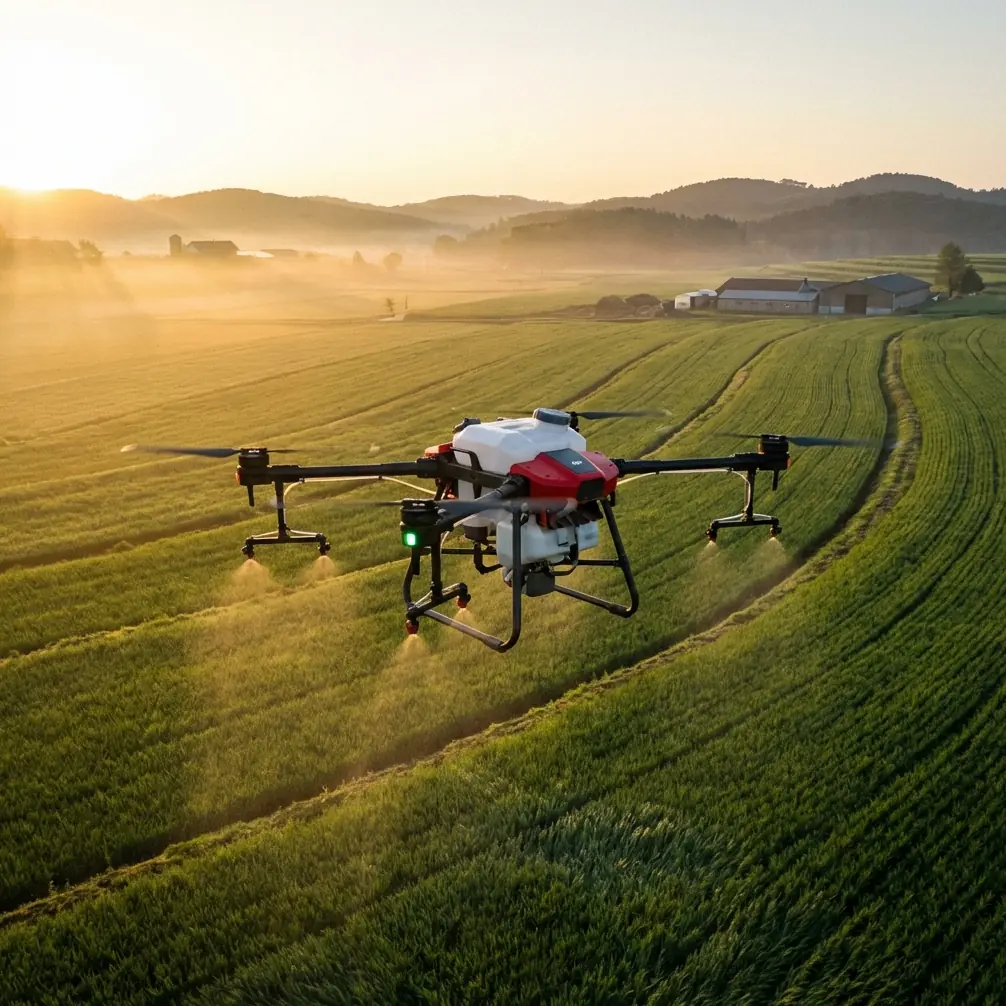
Agras T70P Field Report: Low-Light Scouting, Sensor Discipline, and Smarter Range Habits
META: A field-focused look at Agras T70P scouting in low light, with practical guidance on obstacle sensing limits, antenna positioning, RTK discipline, and how precise distance awareness affects real farm operations.
I spend a lot of time watching operators blame darkness for problems that actually begin with assumptions.
Low-light field scouting with an Agras T70P is one of those jobs where discipline matters more than bravado. When visibility drops, people naturally lean harder on the aircraft’s sensing stack, on RTK confidence, on telemetry range, and on the belief that the drone will “see” enough to keep the mission clean. Sometimes it will. Sometimes it won’t. The difference usually comes down to whether the operator understands the edges of the system, not just its headline capability.
That matters for the T70P because scouting is rarely a standalone activity. It sits upstream of spraying decisions, nozzle calibration checks, route planning, swath width selection, and drift management. If your early pass over the field is sloppy, the rest of the workflow inherits that error. A few meters of uncertainty near a tree line, irrigation riser, power pole, or storage wall may not sound dramatic on paper. In practice, it can ripple through the whole operation.
What low-light scouting really tests
People describe low-light missions as a visibility problem. That is only partly true.
In real farm use, low-light scouting tests three things at once:
- How well the aircraft can maintain reliable spatial awareness near obstacles.
- How well the pilot can interpret sensor feedback under uncertainty.
- How cleanly the positioning chain holds together when field edges, structures, and terrain start complicating the picture.
The reference material behind this piece comes from a very different platform category, an educational DJI drone with a front-facing TOF sensor, but the lesson transfers well to professional agricultural aircraft: obstacle awareness is conditional, measurable, and range-limited. In that source, the front TOF function only becomes available when an expansion module is installed, and the documented maximum measuring distance is 1.2 meters against an indoor white wall. That specific setup is not a T70P specification, and no serious operator should treat it as one. But it exposes a critical operational truth: sensing performance depends on configuration and target reflectivity, and the best-case number is usually measured on a friendly surface.
That is exactly the mindset to bring to low-light T70P scouting.
If you are flying near field sheds, stacked inputs, pump houses, greenhouse edges, parked machinery, or orchard perimeter structures, your confidence should never come from a generic belief in “obstacle avoidance.” It should come from understanding what the aircraft is likely to detect well, what it may detect poorly, and how much margin you personally maintain when light conditions are working against visual confirmation.
Why a 1.2-meter lesson still matters on a much larger ag platform
The educational reference includes a simple but revealing method: place the drone facing a wall, move it gradually farther away, measure actual distance with a tape, and compare that real-world number to the sensor output shown on the display. The displayed value is converted from millimeters to centimeters by dividing by 10 and rounding, making it easier to read.
That tiny detail is more useful than it looks.
It reminds us that field robotics should be validated against reality, not trusted abstractly. Operators love to talk about centimeter precision when discussing RTK fix rate, but many skip the simpler question: how often do you verify what the machine thinks it sees against what is physically there?
For the Agras T70P, that habit can sharpen several parts of your scouting workflow:
- Perimeter verification: Before a low-light mission, confirm actual clearance around known structures instead of relying on memory from daytime.
- Route margin planning: If the scouting pass is meant to inform spray routes later, validate the safe offset from trees, fences, poles, and field entrances.
- Terrain perception checks: In dim conditions, embankments and drainage transitions can appear flatter than they really are. Ground-truthing helps prevent overconfidence.
- Sensor expectation management: Reflective, dark, wet, dusty, or irregular surfaces may not behave like ideal test targets.
The lesson is not that the T70P has a 1.2-meter sensing limit. It does not mean that. The lesson is that every detection system has conditions, and every operator should know the difference between a laboratory-friendly reading and a field-trustworthy margin.
Low light changes how you should think about scouting speed
There is another reference in the source set that seems unrelated at first glance: a training text on four-point hesitation rolls in model aircraft aerobatics. Not agricultural, not autonomous, not about farm drones. Still, one principle is excellent: the pilot should stay ahead of the aircraft instead of reacting late to what it has already started doing.
That source emphasizes pauses every 90 degrees and notes that the maneuver requires higher speed and a slightly steeper climb than a normal aileron roll. Again, nobody should import aerobatic technique into agricultural operations. But the mental model is worth keeping: when a task becomes more timing-sensitive, the solution is not always to slow down blindly. It is to control the rhythm of the operation so the aircraft is not forcing the pilot into delayed reactions.
For low-light scouting with an Agras T70P, that translates into a practical rule:
Do not fly so fast that the aircraft’s observations arrive too late for your own decision cycle.
That sounds obvious, but in farming it often gets ignored. Operators hurry the scouting pass because they want to begin spraying before wind shifts, before dew changes leaf wetness, or before labor moves to the next task. The result is a rushed survey that leaves blind spots at exactly the points where you most need confidence: corners, obstructions, access lanes, and uneven boundaries.
A better approach is to build a repeatable pace. Not slow for the sake of caution. Predictable for the sake of awareness.
Think in terms of rhythm:
- Straight segment.
- Confirm position stability.
- Cross-check obstacle context.
- Verify edge geometry.
- Reassess antenna orientation and link quality.
- Continue.
That cadence keeps you in front of the aircraft. It also improves the quality of any later spray mission, because your scouting data and mental map are cleaner.
Antenna positioning advice for maximum range
This is where many good pilots quietly lose performance.
When operators complain about reduced control range or unstable signal at field margins, the cause is often not the drone at all. It is poor antenna discipline at the controller. The fix is rarely dramatic, but it matters.
For the best link performance during low-light scouting with an Agras T70P:
- Keep the controller antennas oriented so the broadside of the antenna pattern faces the aircraft, rather than pointing the antenna tips directly at it.
- Maintain as clear a line of sight as the field allows. Parked trucks, sheds, tree belts, and even the operator’s own body can degrade signal quality.
- If the mission tracks along a long field edge, reposition yourself before the drone reaches an oblique angle that forces the signal through obstacles.
- Avoid standing low behind embankments or near metal structures that can reflect or absorb the link.
- In mixed terrain, choose a launch point that gives you a clean visual corridor toward the farthest likely section of the scouting route.
That last point matters more than many teams realize. Launch-site discipline often does more for usable range than any amount of post-flight debate about firmware or weather.
If you want a practical walkthrough for controller stance and antenna orientation in the field, this quick range-setup contact channel is a useful place to ask for a diagram-based explanation.
Why RTK confidence still needs humility
Agras operators rightly care about RTK fix rate because centimeter precision underpins efficient agricultural work. It affects line placement, overlap control, and consistency from pass to pass. But low-light scouting introduces a subtle trap: RTK precision can make pilots feel more certain than the environment justifies.
Positioning precision is not the same thing as environmental comprehension.
You may know exactly where the aircraft is in space and still be wrong about what lies just ahead, especially near dark vegetation, wires, narrow poles, or irregular edges at dusk. This is why I treat RTK as a geometric foundation, not a substitute for conservative obstacle margins.
When scouting is being done to support later spraying, that distinction also affects spray drift management. If your route definition near the boundary is inaccurate because you misread the real physical edge in low light, you can end up planning spray lines too aggressively. That raises the chance of off-target application near roads, neighboring plots, water channels, or sensitive crop zones.
A careful scout creates better downstream decisions:
- cleaner headland definition,
- more credible swath width planning,
- better boundary offsets,
- less guesswork in nozzle placement strategy.
The overlooked value of visible, simplified sensor readouts
One small detail from the educational TOF experiment deserves more attention. The system simplifies a millimeter-based reading into centimeters and scrolls the number across an 8×8 red-blue LED matrix. Primitive? By enterprise standards, yes. Effective? Also yes.
There is a reason simplified readouts work in field robotics. They reduce cognitive load.
In low-light agricultural operations, the operator already has enough to process: aircraft attitude, field geometry, link quality, battery status, terrain changes, and mission intent. Dense, overcomplicated displays can actually make the pilot slower to notice the one thing that matters. A clean distance or alert presentation often has more operational value than a richer but cluttered interface.
That should shape how you set up your T70P mission environment:
- prioritize the telemetry elements you will actually act on,
- reduce screen clutter before the flight,
- define alert thresholds that correspond to decisions, not just curiosity,
- brief any second operator or spotter on which cues matter most.
The point is not to make the workflow simplistic. It is to make it legible under pressure.
Scouting before spraying: where precision pays off
The T70P conversation usually gravitates toward productivity metrics. That is understandable. But low-light scouting deserves equal respect because it determines whether later productivity is precise or merely fast.
A disciplined scout helps answer questions that directly influence application quality:
- Is the planned swath width realistic near irregular boundaries?
- Are there airflow corridors near tree gaps that may worsen spray drift?
- Do crop-height transitions suggest adjusting operating assumptions before treatment?
- Are there obstacle clusters that could force line shortening or route segmentation?
- Is there enough positional confidence at the margins to preserve consistent overlap?
If your operation also uses multispectral data elsewhere in the workflow, low-light visual scouting should be treated as complementary rather than interchangeable. Multispectral can reveal crop variability and stress patterns, but it does not remove the need for clean spatial judgment in the immediate operating environment. The best teams combine data layers without pretending that one replaces the others.
A practical low-light T70P checklist I actually trust
Before takeoff:
- Walk the launch zone and pick the best line-of-sight position, not just the nearest convenient one.
- Check controller antenna orientation before you power into the mission mindset.
- Identify hard obstacles at field edges that will be harder to interpret after dark.
- Confirm RTK status, but do not let a strong fix justify tighter obstacle margins.
During the scouting pass:
- Maintain a steady rhythm that keeps your decision-making ahead of the aircraft.
- Use conservative stand-off distances near structures and uncertain edges.
- Watch for wet, dark, or irregular surfaces that may complicate sensing.
- Reposition yourself if signal geometry starts degrading at the far edge.
After the pass:
- Review any boundary sections that felt ambiguous.
- Correct route assumptions before spray planning begins.
- Use the scout to refine nozzle calibration strategy and line placement, not merely to confirm that the field is “flyable.”
The bigger takeaway
Low-light scouting with an Agras T70P is not about proving how much the aircraft can handle. It is about learning where precision ends and judgment begins.
The most useful insight from the reference materials is not a hardware spec in isolation. It is the operator mindset behind them. One source documents a sensor test against a wall, with a stated 1.2-meter maximum under favorable conditions. Another teaches pilots to stop reacting late and instead structure movement around deliberate timing at 90-degree intervals. Put those ideas together and you get a better field habit: measure reality, simplify what you monitor, and stay ahead of the machine.
That is what makes a low-light scouting mission worth doing. Not speed. Not confidence theater. Not wishful trust in automation.
Clear margins. Clean rhythm. Better decisions before the spray ever starts.
Ready for your own Agras T70P? Contact our team for expert consultation.