
Agras T70P Scouting Tips for Dusty Fields: Flight Height
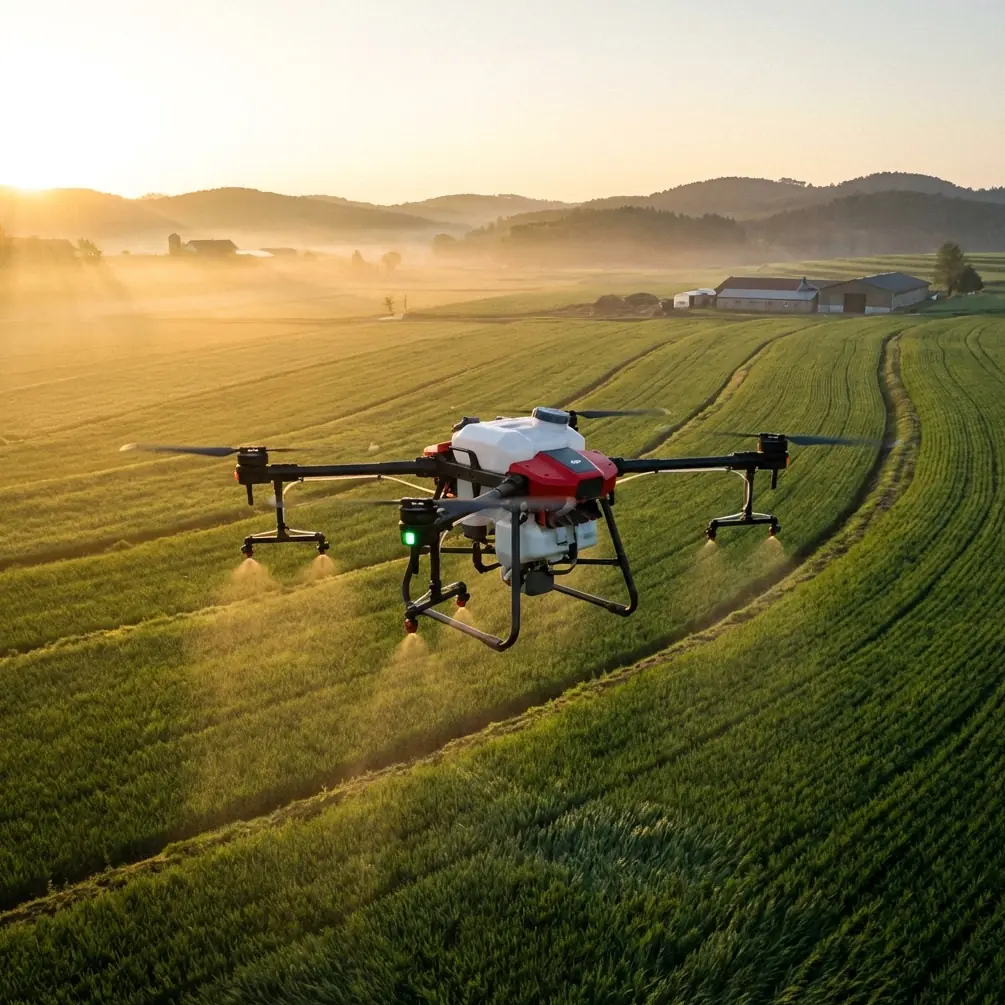
Agras T70P Scouting Tips for Dusty Fields: Flight Height, Mapping Workflow, and Why Precision Starts Before Spraying
META: Practical Agras T70P scouting tips for dusty agricultural fields, including optimal flight altitude strategy, mapping workflow, obstacle awareness, and model-building insights for cleaner field decisions.
Dusty fields expose a weakness in many drone operations: people focus on the spray mission and ignore the information mission that should come first.
That is where the Agras T70P deserves a more disciplined workflow. If your goal is to scout dry, dusty farmland before treatment, the real challenge is not just getting the aircraft into the air. It is extracting reliable field intelligence when visibility, surface texture, and environmental contamination can reduce image quality and decision confidence. In those conditions, flight height, route planning, obstacle handling, and downstream modeling matter more than most operators admit.
As Dr. Sarah Chen, I would frame it this way: a scouting mission in dusty conditions should be treated as a data-collection exercise with agronomic consequences. If the visual record is weak, nozzle calibration decisions may be delayed, spray drift risk may be judged poorly, and swath planning can become too conservative or too aggressive. The T70P is often discussed as a field workhorse, but for scouting, it should be used as part of a wider precision workflow rather than as an isolated aircraft.
Start with the right objective: scouting is not the same as spraying
A dusty field can hide the difference between crop stress, soil exposure, tramline compaction, and residue patterns. That means your first pass should answer a narrow question. Are you checking emergence uniformity? Looking for missed zones after prior application? Verifying whether dust-prone edges near roads need a different treatment window? Identifying low-visibility obstacles before a full operation?
This matters because the ideal flight altitude changes with the job.
If the purpose is broad reconnaissance of field access, dust sources, headland condition, and obstacle exposure, a higher scouting pass is usually safer and more efficient. If the purpose is plant-level visual interpretation or creating a more detailed field surface model, lower altitude becomes more valuable. The mistake is flying one generic mission height and hoping it suits every agronomic decision.
Optimal flight altitude insight for dusty fields
For dusty scouting, the best operational principle is simple: begin higher than you think, then step down only if the imagery does not support the decision you need to make.
Why? Dust changes contrast. Near the surface, rotor wash and local airborne particles can degrade image clarity, especially over dry bare patches, service roads, or recently trafficked field edges. A slightly higher initial pass often gives you more stable situational awareness and cleaner coverage of the whole block. It also reduces the chance that low-level turbulence near the canopy or ground will compromise what you are trying to interpret.
In practical terms, I recommend a two-stage altitude logic for T70P scouting in these conditions:
- Stage 1: medium-height overview pass for whole-field interpretation, access paths, standing obstacles, and dust concentration zones.
- Stage 2: lower targeted passes only over problem sections where finer detail is needed.
This approach is operationally significant for two reasons.
First, it limits unnecessary exposure to the worst dust layer. Second, it keeps your scouting dataset structured: overview imagery for field decisions, close inspection imagery for exceptions. That is far more useful than returning with one inconsistent batch of images from mixed heights.
If your farm workflow includes RTK fix rate monitoring and centimeter precision for field boundaries or repeatable treatment lines, the altitude decision becomes even more important. Stable, repeatable geometry is easier to preserve when the mission profile is intentional rather than improvised. Precision is not only about the navigation stack; it is also about collecting imagery that supports repeat visits under comparable conditions.
Dusty fields demand stronger obstacle discipline
One useful lesson comes from mapping-oriented DJI engineering rather than agriculture marketing. In a DJI surveying and engineering solution document, the Phantom 4 Pro is highlighted for five-direction sensing and four-direction obstacle avoidance, specifically because this helps it avoid urban structures while maintaining stable flight. It also lists a 30-minute flight time, 20 m/s maximum horizontal speed, and tolerance for Level 5 wind, or 10 m/s.
The Agras T70P is a different aircraft for a different mission set, but the operational takeaway transfers well: when visibility is degraded by dust, obstacle intelligence becomes part of scouting quality, not just flight safety.
That matters at the farm level. Dry fields often combine dust with irrigation gear, utility edges, tree lines, poles, and ad hoc equipment staging. A T70P scouting route should therefore be designed to reveal obstacles before the main operation, not merely to inspect crop condition. If dust dulls local contrast, poles and wires can become harder to interpret visually in postflight review. A broad first pass helps create cleaner spatial context.
This is also where a realistic swath width strategy begins. Operators sometimes think about swath width only in relation to application efficiency. In practice, scouting reveals whether dust-prone zones, narrow margins, or irregular field boundaries justify changing the application pattern later. Better scouting leads to fewer last-minute corrections during field work.
Use mapping logic, not just visual impressions
Another reference point from the source material is even more valuable for T70P users who want better decision support. The emergency mapping solution document describes DP-Smart, a 3D oblique photogrammetry modeling platform that works with multi-source air-and-ground image sequences and automates steps such as aerial triangulation, dense point cloud generation, TIN construction, and automatic texture mapping. It also mentions DP-Modeler, which combines orientation, mapping, and modeling in one workflow and is designed to extract accurate building outlines through multi-angle observation.
Why should an Agras T70P operator care?
Because dusty-field scouting improves dramatically when it moves beyond “I saw something in the video.” If your farm or service team is responsible for large blocks, repeated missions, drainage interpretation, edge encroachment, farm road deformation, or obstacle documentation, then building structured visual outputs matters. You may not need a full urban-style 3D model for every field, but the principle is strong: multi-angle image capture processed into a consistent model can outperform casual review of still frames.
The operational significance of those software details is easy to miss:
- Automated aerial triangulation and dense point cloud generation mean repeatable geometry, which helps when comparing one scouting date to another.
- TIN and texture workflows help convert a confusing set of dusty images into a surface that is easier to interpret spatially.
- Integrated mapping and modeling reduces the gap between “inspection” and “usable field record.”
For a T70P program, that translates into better pre-application planning. You can identify uneven surfaces, vehicle access problems, or troublesome boundaries before they disrupt a spray day. It also supports training: newer operators can learn from structured models rather than from memory alone.
Don’t let image quality become the weak link
The DJI mapping reference also mentions a payload with a 1-inch CMOS sensor, 20 megapixels, and a mechanical shutter, plus support for 4K video and a high-bright remote screen with 1920×1080 resolution and 1000 cd/㎡ brightness. Again, this is not a T70P specification sheet. But it highlights something T70P users should respect: usable scouting depends on image discipline as much as aircraft capability.
Dusty fields punish weak imaging practice. If the light is harsh, low-angle sun can amplify haze. If your display is not bright enough, operators may miss subtle contrast transitions in real time. If the mission is flown too fast for the viewing task, apparent problem areas may never be verified properly.
So even with a capable agricultural platform, treat your scouting mission like an imaging mission:
- Fly at a speed that preserves interpretability.
- Review edge zones, roads, and dry patches carefully.
- If the first pass looks washed out, don’t force interpretation. Refly a smaller section under a better angle or different altitude.
This is where multispectral workflows can also add value when available in a broader farm program. Not every dusty field mission needs multispectral data, but in cases where visible imagery is confounded by dust and soil brightness, additional spectral context can help separate plant stress from surface reflectance artifacts. The key is matching the sensing approach to the agronomic question, not collecting extra data for its own sake.
A practical T70P scouting workflow for dusty conditions
Here is the field routine I recommend.
1. Inspect the dust pattern before takeoff
Do not judge only by the crop. Look at roads, vehicle traffic, headlands, exposed soil bands, and nearby work activity. Dust sources shape mission quality.
2. Set a medium-height reconnaissance route first
This first pass is for orientation, boundary confirmation, obstacle exposure, and identification of zones that deserve closer review. In dusty conditions, this is usually more valuable than rushing into a low-altitude run.
3. Mark zones for targeted lower passes
Once the overview is complete, reduce altitude selectively. Focus on inconsistent crop tone, suspected stand gaps, drift-sensitive edges, drainage anomalies, or obstacle-heavy margins.
4. Tie scouting to application decisions
Your notes should connect directly to operations:
- Does dust buildup suggest delaying application to reduce spray drift?
- Do edge conditions imply a narrower effective treatment zone?
- Is nozzle calibration likely to need adjustment based on crop stage and coverage expectations?
- Do field boundaries support repeatable lines with centimeter precision?
5. Export structured outputs
Even a simple annotated orthomosaic or modeled field section is better than a folder of unlabeled clips. If your team uses photogrammetry software such as DP-Smart or DP-Modeler, this is the point where that investment pays off.
6. Archive with repeatability in mind
Dusty fields change fast. Save mission height, timing, wind conditions, and the reasoning behind the route. The value is not the one flight. The value is comparability.
Why this matters more than people think
Agras operators are often judged by hectares covered. That is too narrow.
The stronger measure is whether the aircraft operation improves agronomic timing and reduces avoidable field risk. A well-run scouting mission can prevent a poor application window, reveal where drift exposure is highest, show where access will be difficult, and document whether the field is ready for a uniform pass. In dry conditions, that intelligence is rarely obvious from the ground.
The airshow reference in the source material described aerial performance over the Beijiang River as an airborne “ballet.” It is a vivid phrase, but for field operations the lesson is different. Precision flying only becomes valuable when it produces useful outcomes on the ground. Grace in the air means very little if the resulting data cannot support a practical farm decision.
That is exactly why the T70P should be treated as part of a scouting system. Aircraft stability, route discipline, viewing quality, model generation, and agronomic interpretation all connect. If one of those elements is weak, dusty conditions will expose the weakness quickly.
When to ask for support
If you are building a scouting workflow around the Agras T70P and need help deciding how to structure flight profiles, image review, or mapping outputs for dry-field conditions, it helps to compare your use case with teams already doing this in production. For direct field-workflow discussion, you can message a specialist here.
The best T70P scouting practice is rarely about flying lower or faster. It is about flying deliberately, with a mission architecture that respects dust, data quality, and the downstream decisions that depend on both.
Ready for your own Agras T70P? Contact our team for expert consultation.