
Agras T70P Mapping Guide for Mountain Vineyards
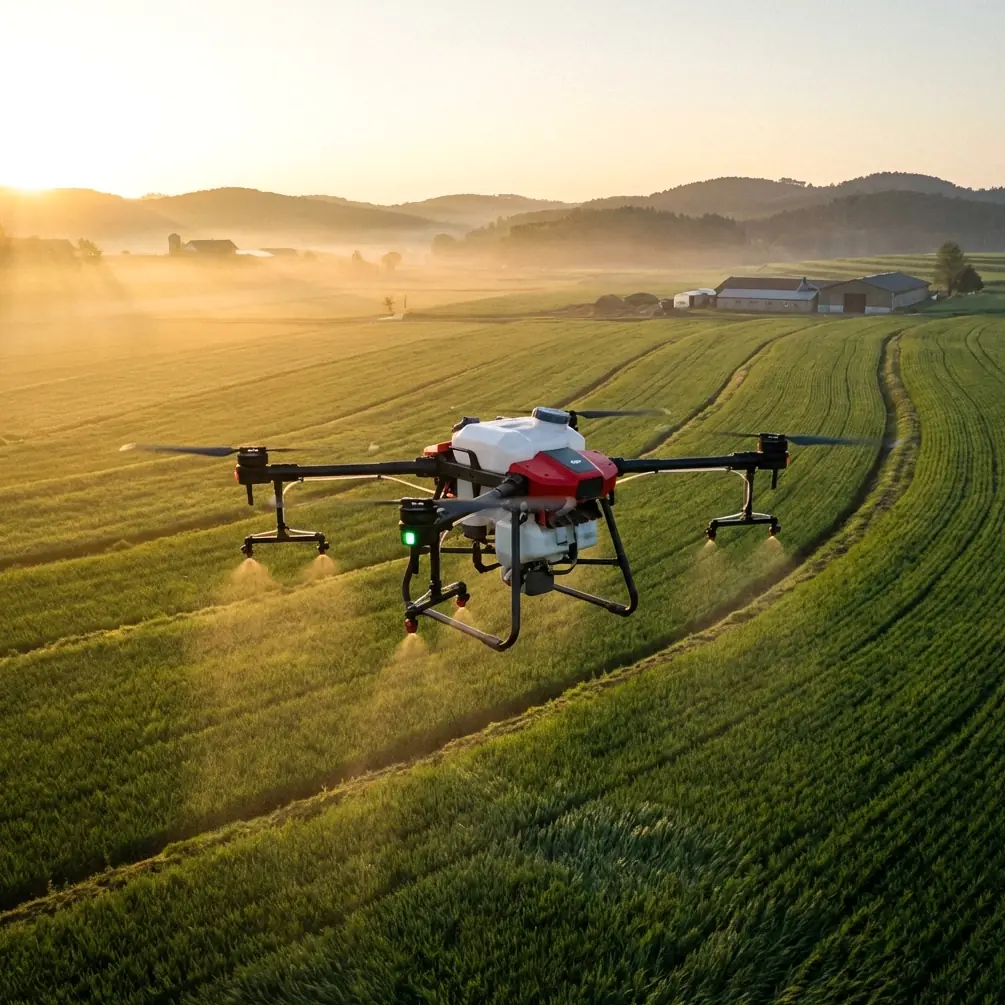
Agras T70P Mapping Guide for Mountain Vineyards: Flight Altitude, RTK Discipline, and Terrain-Smart Workflow
META: Practical Agras T70P tutorial for mapping mountain vineyards with altitude planning, RTK fix strategy, swath control, nozzle calibration awareness, and field-ready best practices.
Mountain vineyards are unforgiving places to map well. Rows break across steep contours. Terrace edges distort visual judgment. Wind can shift by section, not just by day. A flat-field workflow that performs acceptably in broadacre agriculture often falls apart once elevation changes start stacking across the block.
That is where the Agras T70P becomes interesting. Not because “bigger” automatically means better, but because this class of platform gives operators enough payload, positioning discipline, and field resilience to work in places where terrain is the real variable. If your actual task is mapping vineyards in mountain conditions, the aircraft setup matters less than the quality of your operational decisions: flight altitude, RTK behavior, terrain following logic, and how you manage overlap along irregular rows.
This tutorial is written around that exact scenario.
Why mountain vineyard mapping is different
A vineyard on a slope is not just a vineyard tilted sideways. The geometry changes everything.
Rows may run parallel at one elevation, then kink around a drainage line. Vines on upper terraces may be more exposed, while lower sections sit in calmer, cooler air. The canopy itself creates a repeating pattern that looks simple from above but can confuse lower-quality mapping datasets if altitude and overlap are not carefully controlled.
With the Agras T70P, the goal is not merely to collect images or generate a field outline. The goal is to preserve enough consistency across the site that your maps remain useful for downstream agronomy: vigor comparison, drainage interpretation, disease scouting routes, and application planning. In practical terms, that means protecting three things:
- positional integrity
- terrain-relative altitude
- repeatable swath behavior
If one of those breaks, your vineyard map may still look visually acceptable, but the decisions built from it become less trustworthy.
Start with the altitude question, not the mission template
Most mapping mistakes in mountain vineyards begin with altitude selected as a convenience number.
Operators often choose a single height above takeoff point, launch, and then wonder why image scale changes dramatically across the slope. On a mountain vineyard, that is the wrong frame of reference. Your working altitude should be planned relative to canopy and terrain, not the launch pad.
For the Agras T70P in this scenario, a sensible starting insight is to fly roughly 20 to 30 meters above the vine canopy, then adjust based on row spacing, slope severity, and the quality of terrain following available on site. That range is not a magic setting. It is a field-tested compromise.
Why this altitude band works:
- It is low enough to preserve row detail and block-to-block differentiation.
- It is high enough to smooth out minor terrain undulations without forcing the aircraft into constant aggressive vertical corrections.
- It helps maintain more uniform ground sampling across sloped sections than a single absolute-height mission flown too high above one part of the site and too low over another.
In steeper vineyards, staying closer to the lower end of that range usually improves detail, but only if terrain following remains reliable and obstacle margins are respected. If the aircraft is making excessive altitude corrections, the dataset can become less consistent even though the nominal height looks ideal on paper.
So the better question is not “What altitude should I use?” but “At what terrain-relative altitude does the T70P maintain stable motion, clean overlap, and a safe canopy margin across the entire block?”
That is the number you keep.
RTK fix rate matters more in terraces than in open fields
The phrase “centimeter precision” gets thrown around too casually. In mountain vineyards, it has operational meaning.
A strong RTK fix rate is not just a nice specification box to tick. It is the difference between a repeatable path and one that slowly drifts across narrow vineyard geometry. Terraces and edge rows expose positioning weakness quickly. If your fix drops intermittently, you can end up with inconsistent line spacing, overlaps that vary by section, and maps that become harder to align with previous flights.
For the Agras T70P, maintaining RTK stability should be treated as part of mission planning, not something you check after takeoff. In mountain terrain, signal conditions can change due to slope shielding, nearby structures, and uneven horizon visibility. Before mapping the full vineyard:
- verify that the aircraft is holding a stable RTK-fixed solution at the launch area
- test a short route along both upper and lower blocks
- watch for any fix degradation near ridgelines, walls, or tree boundaries
- avoid assuming the best GNSS performance at the highest point means equal performance everywhere
Operationally, this matters because vineyard maps are often revisited. If your first mission and your follow-up mission do not sit on the same spatial foundation, vigor comparison, canopy change analysis, and treatment-zone planning become less reliable. Repeatability is the real value of centimeter-level positioning.
Swath width in vineyards is not just about coverage efficiency
Broadacre operators usually think of swath width as a productivity variable. In mountain vineyards, it is also a data quality variable.
Even if your Agras T70P workflow supports generous lateral coverage, the temptation to widen passes should be resisted when row structure is narrow, terraced, or interrupted by access tracks. In these conditions, a narrower effective swath often improves consistency because the aircraft does not need to “reach” across rapidly changing terrain and vine geometry.
Why it matters:
- tighter swath control reduces distortion across row edges
- overlap remains more predictable when the terrain shape changes mid-pass
- terrace boundaries and non-planted gaps are less likely to smear into neighboring data
If your vineyard has irregular row lengths, split the mission by block rather than forcing one large grid over the whole property. The T70P may be physically capable of handling complex acreage, but your best map often comes from smaller, terrain-aware mission segments.
Multispectral thinking starts before you process any data
The mention of multispectral in vineyard mapping usually leads straight to imagery products and vegetation indices. That skips the more important point: multispectral value depends on whether your flight was disciplined enough to support meaningful comparison.
In mountain vineyards, sunlight angle, shadow movement, and slope orientation can alter canopy appearance dramatically. If you intend to use the T70P-derived map to support multispectral interpretation or compare it with other datasets, consistency in time of day and altitude becomes critical.
A practical approach:
- fly when shadows are present but not dominant, often later morning once low-angle contrast has softened
- avoid patchy cloud conditions if repeatability is a priority
- keep terrain-relative altitude stable from block to block
- repeat mission direction on future flights where possible
This is where RTK and altitude planning connect. Multispectral analysis gains value only when spatial and geometric consistency are controlled. Otherwise, you are comparing vine response mixed with collection variability.
Nozzle calibration and spray drift still belong in a mapping conversation
At first glance, nozzle calibration and spray drift sound like spraying topics, not mapping topics. In mountain vineyards with an Agras T70P, they are connected.
Why? Because mapping is rarely isolated from application planning. The same operator, aircraft, and terrain model often feed later spray missions. A poor map can cascade into poor application geometry. Conversely, a terrain-aware map can directly improve safe, efficient spraying decisions.
Here is the link.
If your map captures row spacing, terrace transitions, and canopy edges accurately, you can calibrate later spray operations with much more confidence. Nozzle selection and calibration depend on intended deposition behavior, row architecture, and travel consistency. If your mapped rows are misaligned or your block edges are vague, the eventual spray plan is already compromised.
The same applies to spray drift risk. Drift management in mountain vineyards is heavily influenced by local airflow and slope breaks. During mapping, pay attention to zones where wind behaves differently: saddles, exposed upper rows, leeward corners, and abrupt terrace drops. Mark these in your notes. They may become the areas where you later reduce speed, adjust droplet strategy, or alter spray timing.
A map is not just a picture of the vineyard. It is a decision surface.
How IPX6K matters in real vineyard work
The IPX6K rating is easy to overlook until you operate in the conditions that define vineyard seasons: wet foliage, muddy launch points, dust after vehicle movement, and rinse-down requirements between blocks.
For a mountain vineyard crew, this level of ingress resistance has practical value. It supports more confident operation around moisture and routine contamination, especially when aircraft and equipment are exposed to water, residue, and fine field debris throughout the day. That does not excuse poor maintenance, but it does make the platform more realistic for commercial agricultural use where conditions are rarely clean.
Its significance is operational rather than promotional. Less vulnerability to harsh field conditions means fewer interruptions, more reliable turnaround, and less hesitation when weather or terrain makes the work messy.
A practical T70P workflow for mountain vineyard mapping
Here is the sequence I recommend for this scenario.
1. Break the vineyard into terrain-coherent sections
Do not plan one giant mission unless the site is unusually uniform. Divide by terrace band, slope aspect, or row orientation. This improves overlap consistency and simplifies troubleshooting.
2. Establish canopy-relative altitude
Begin around 20–30 m above canopy. Review whether the aircraft can hold that height smoothly across elevation changes. If vertical corrections are too aggressive, raise altitude slightly rather than forcing unstable terrain hugging.
3. Confirm RTK before committing
Do a short validation leg through both high and low sections. If the RTK fix rate is unstable, solve that first. A beautiful-looking flight with inconsistent positioning is not a professional dataset.
4. Use conservative swath planning
Favor predictable overlap over theoretical efficiency. In narrow vineyards, disciplined line spacing usually outperforms aggressive width settings.
5. Record environmental notes
Wind on ridges, shadow-heavy corners, reflective leaves, and damp sections all matter later. Your flight log should include observations that explain what the map may show.
6. Build for repeatability
If this is the first mission of the season, think ahead. Future comparisons become far more useful when altitude, direction, timing, and block segmentation are consistent.
The most common altitude mistake on steep blocks
The mistake is flying too high to “be safe.”
That sounds sensible, but excessive altitude in mountain vineyards often reduces the very data quality you came to collect. Rows become less distinct. Terrace edges lose definition. Gaps and stressed canopy zones blend into a more generalized surface. If your goal is practical vineyard intelligence rather than a broad visual overview, too much height can be just as damaging as too little.
The safer approach is controlled proximity: fly as low as the aircraft can maintain stable, terrain-relative performance with dependable RTK and clean obstacle margins. For many mountain vineyards, that is why the 20–30 meter canopy-relative window is such a useful starting point.
What a good map should help you decide
When your Agras T70P mission is done, the value of the output should show up in decisions, not just in image sharpness.
A useful mountain vineyard map should help you answer questions like:
- Which blocks show uneven canopy development by elevation?
- Where do terrace transitions create application complexity?
- Which rows are likely to need special attention in later spray planning?
- Where will drift risk be higher because airflow changes around topography?
- Can future flights be repeated with the same spatial confidence?
If the map cannot support those decisions, revisit the workflow. Usually the weak point is altitude logic, RTK discipline, or over-ambitious mission width.
Final field note
Mountain vineyards reward operators who think in layers. The aircraft is one layer. Positioning is another. Terrain modeling, overlap control, and environmental interpretation are layers too. The Agras T70P is strong when those layers are aligned, especially in demanding agricultural terrain where consistency matters more than spectacle.
If you are planning a site-specific workflow and want to compare mission setups for steep vineyards, this direct WhatsApp line for Agras field questions is a practical place to continue the discussion.
Ready for your own Agras T70P? Contact our team for expert consultation.