
Agras T70P Near Power Lines at Dusk: A Field Report
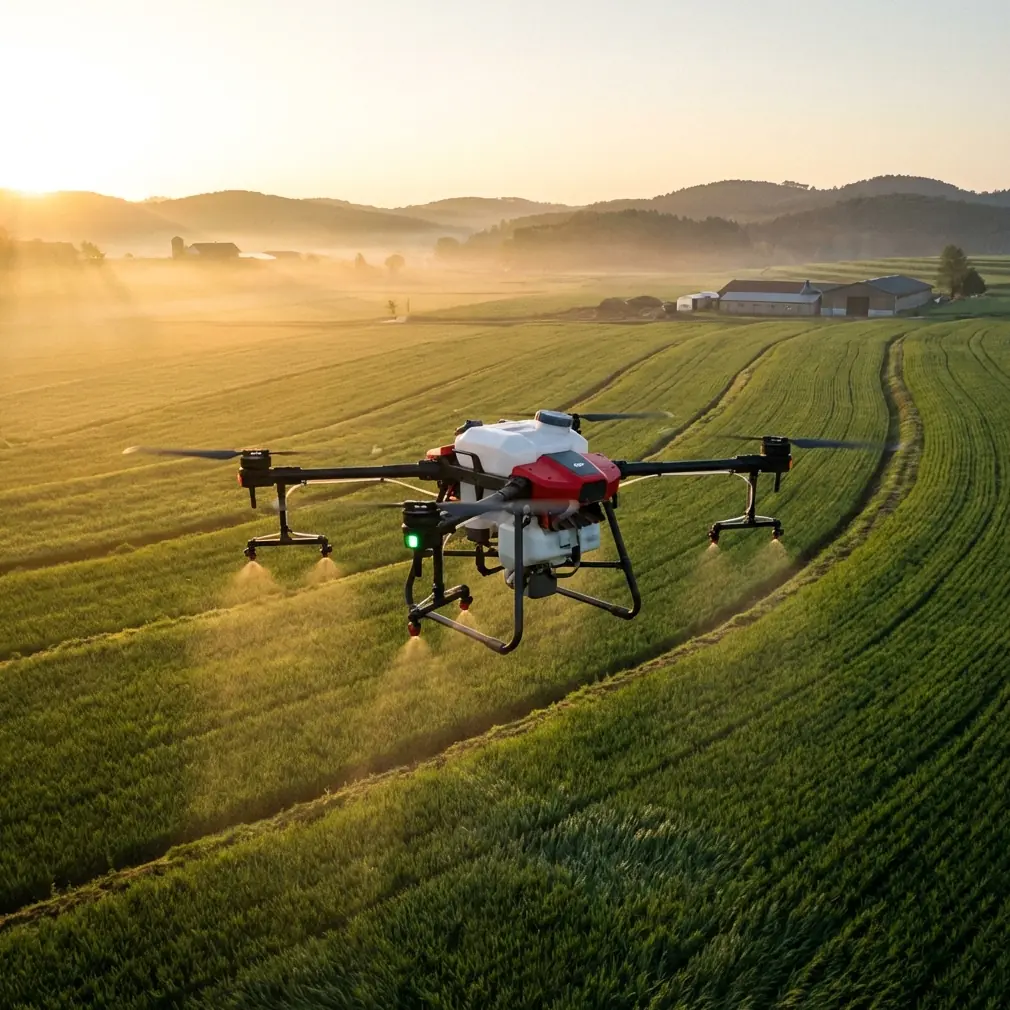
Agras T70P Near Power Lines at Dusk: A Field Report on Positioning, Interference, and Precision Work
META: Expert field report on using the Agras T70P near power lines in low light, with practical insight on RTK fix stability, electromagnetic interference, antenna adjustment, nozzle calibration, drift control, and IPX6K durability.
By Dr. Sarah Chen
The Agras T70P is usually discussed as an agricultural platform, but that framing misses something useful: in skilled hands, it can also become a disciplined aerial tool for infrastructure-adjacent work, especially where vegetation control, corridor assessment, and precision application overlap. Around power lines, those overlaps are real. Utilities and contractors often need to inspect access routes, identify encroaching growth, document wet ground conditions, or perform tightly managed treatment in rights-of-way where low light complicates every decision.
That is where the T70P becomes interesting—not as a generic “big drone,” but as a machine whose value depends on how well the operator manages three things at once: positional confidence, environmental contamination of the signal environment, and application accuracy. Near energized lines at dusk, each one presses against the others.
This field report looks at the T70P from that exact angle.
Why low-light power line work exposes the real strengths and weaknesses of a platform
Power line corridors are awkward workspaces for any UAV. The visual scene is low contrast. Conductors and hardware can be difficult to resolve against darkening terrain. Magnetic and electromagnetic noise can become more pronounced around certain structures and alignments. Add moisture in the air or uneven ground reflectivity, and the pilot is no longer just flying a route. The pilot is constantly evaluating data quality.
With the T70P, the first operational question is not payload capacity or marketing-level productivity. It is whether the aircraft can hold centimeter precision when the environment is trying to degrade your confidence in the solution.
That is where RTK fix rate matters. In open agricultural fields, many pilots take stable RTK for granted. Along transmission or distribution corridors, that assumption can break down. A weak or inconsistent fix is not a minor inconvenience. It affects line-following stability, mapping repeatability, and any task that depends on consistent offset from a boundary or obstacle. If you are documenting regrowth under a line or applying treatment near poles and anchor points, a drifting solution changes the quality of the entire job.
The T70P’s appeal in this kind of work is tied directly to whether it can maintain a reliable RTK fix rate under pressure. When operators talk about centimeter precision, this is what they really mean in practice: not a best-case number on a clear day, but repeatable spatial confidence when the airframe is working close to an electrically noisy corridor in fading light.
Electromagnetic interference is not abstract. You can feel it in the workflow.
One of the most useful habits around power lines is treating electromagnetic interference as a live field condition, not a technical footnote. Operators often wait too long to respond, hoping a noisy heading or unstable positional solution will “settle down.” Near line infrastructure, that delay can ripple into the mission.
With the T70P, antenna adjustment becomes more than setup housekeeping. It is one of the simplest and most overlooked interventions available to the crew. A small change in antenna orientation or ground station placement can improve reception geometry enough to stabilize behavior that otherwise appears random. The key is not mystical. You are trying to reduce the aircraft’s susceptibility to a cluttered signal environment and give the positioning system the cleanest possible view of the sky and correction source.
In one recurring corridor scenario, the aircraft behaves normally on approach, then shows degraded confidence near a structure cluster—crossarm hardware, conductor angles, nearby fencing, and terrain reflections all adding complexity. Pilots sometimes blame the drone first. In reality, the problem can be compounded by poor antenna alignment at the operator position. Adjusting antenna direction to optimize link consistency, then rechecking RTK status before advancing the mission, is often the difference between controlled precision and creeping uncertainty.
This matters because the T70P is large enough and capable enough that you should not be improvising when the signal environment degrades. A disciplined pause for antenna adjustment is not lost time. It is what prevents error propagation across the rest of the operation.
Where nozzle calibration enters a power line discussion
At first glance, nozzle calibration sounds out of place in a report centered on infrastructure inspection. It is not.
Many corridor operations are not pure visual inspection tasks. They include selective vegetation management, spot treatment, or follow-up work tied to what the inspection reveals. In those moments, the T70P stops being just an observation platform and becomes a decision platform. If the nozzles are not calibrated correctly, the aircraft may still fly beautifully while the actual field result is poor.
Near power lines, that is unacceptable for two reasons.
First, the treatment area is often spatially constrained. A narrow right-of-way, variable vegetation height, and nearby non-target surfaces demand predictable output. Second, low-light work makes visual confirmation harder. If application rate or droplet behavior is off, the crew may not notice the problem until the post-flight review or the next site visit.
Calibration is not glamorous, but it is where airframe precision is translated into agronomic or maintenance precision. Flow consistency, nozzle condition, and the relationship between airspeed and output need to be verified before the mission, especially if the aircraft has recently switched between jobs or fluids. A machine with centimeter precision can still produce a poor operational outcome if the spray system is drifting away from spec.
That is why nozzle calibration belongs in the same sentence as RTK fix rate. One governs where the aircraft is. The other governs what the aircraft is actually doing there.
Spray drift is the hidden risk in corridor work
Spray drift sits at the center of civilian utility-adjacent application work. It is the operational risk that turns a technically successful flight into a bad job.
The T70P’s size and downwash can be assets in controlled application, but near power lines and rights-of-way they require respect. Airflow interactions with poles, conductor clearances, embankments, and uneven vegetation can distort the intended deposit pattern. At dusk, crews often enjoy calmer conditions than midday, but low light can also hide subtle drift cues that would be easier to read earlier.
This is where swath width should not be treated as a fixed planning number. On paper, a target swath may look efficient. In the field, around poles and corridor edges, an overly ambitious swath width can increase the chance of undercoverage in one zone and off-target movement in another. The smartest T70P operators narrow the effective working pattern when environmental complexity rises. They trade theoretical throughput for placement confidence.
That decision often looks conservative to inexperienced observers. It is actually evidence of competence.
If the mission includes selective application under or alongside power lines, the crew should be evaluating drift not only as a wind question but as a combined effect of rotor wash, terrain channeling, vegetation structure, and low-light perception limits. The T70P gives the operator enough authority to do precise work. It does not remove the need to think.
IPX6K matters when the corridor is wet, dirty, and unforgiving
The term IPX6K does not excite many readers, but in utility corridors it should. Rights-of-way are rarely clean environments. Mud splatter, fine debris, lingering moisture, and repeated exposure to dirty operating conditions are routine. If you are flying at dawn or dusk, condensation and residual surface moisture are often part of the picture as well.
An IPX6K-rated platform signals a level of resistance to harsh ingress conditions that has direct operational significance. It reduces the fragility penalty that crews often pay when transitioning between field blocks, staging on rough access roads, or working after weather has shifted the site from dusty to soaked. For the T70P, that durability is not just about survival. It supports mission continuity.
When a drone is expected to alternate between inspection support and precision application in a corridor environment, downtime from contamination becomes expensive in time, not just maintenance. A platform with stronger environmental protection lets crews focus more on data quality, treatment accuracy, and route execution, and less on babying the airframe every time conditions turn ugly.
Multispectral thinking, even when the payload conversation stays practical
The word multispectral tends to trigger a mapping discussion, but around power lines its value can be more operational than academic. Vegetation under and adjacent to utility assets does not always announce stress or regrowth uniformly in visible light, especially late in the day. If a T70P workflow is paired with multispectral survey logic—or data collected through a companion process rather than the exact same sortie—it becomes much easier to separate apparent visual calm from emerging growth pressure.
That distinction matters because corridor maintenance is often reactive when it should be predictive. A visually “acceptable” strip at dusk may already be trending toward a future clearance issue. Multispectral analysis can help crews identify where vigor patterns are changing before the problem becomes obvious from the truck window.
For a T70P-centered operation, this means the aircraft can sit inside a larger decision framework. Use the platform for targeted field action where centimeter precision and calibrated delivery matter, but let multispectral intelligence shape where and why those actions happen. That is a more mature use of the machine than treating it as a one-flight solution to every corridor problem.
What I would watch first on a T70P mission near lines
If I were supervising a low-light corridor mission with the T70P, I would watch five indicators before I worried about output numbers.
RTK fix stability
Not just whether RTK is technically active, but whether it is consistently trustworthy near line structures and terrain shifts.Antenna setup discipline
Ground station and antenna adjustment should be revisited the moment the environment changes or signal quality becomes erratic.Realistic swath width selection
Corridor complexity should push operators toward tighter, more defensible coverage assumptions.Nozzle calibration status
Every precision claim collapses if the delivery system is not verified.Drift behavior at the site, not in the forecast
Local rotor-environment interaction matters more than broad assumptions from a weather app.
That sequence reveals something basic about the T70P: its value near power lines is not created by a single specification. It comes from how the platform’s precision systems, environmental resilience, and application behavior hold together under real field pressure.
A note on human factors
Low-light operations near utility corridors are mentally expensive. The pilot’s workload rises because visual cues shrink just as the consequences of poor judgment grow. That makes procedure quality even more important.
The best T70P crews tend to be the least dramatic ones. They brief antenna orientation before launch. They define acceptable RTK behavior in advance. They reduce swath width without ego. They calibrate nozzles even when the aircraft flew well yesterday. They treat IPX6K as protection, not permission to be careless. And they build the mission around what the site is doing, not what the brochure suggested.
That is how you turn a powerful agricultural drone into a dependable corridor tool.
If your team is working through interference, calibration, or low-light operating questions around the T70P, a direct field discussion can save a lot of trial and error. You can reach out here for a practical conversation: https://wa.me/85255379740
Final assessment
The Agras T70P makes sense near power lines in low light when the operation demands more than simple lift capacity. Its real advantage appears when centimeter precision, stable RTK behavior, careful antenna adjustment, and disciplined spray control all matter at the same time. The mention of IPX6K is not a spec-sheet flourish in this context; it is relevant to muddy, wet, debris-heavy corridors. The emphasis on nozzle calibration and drift control is not agricultural baggage; it is what separates exact treatment from avoidable spread. And the nod to multispectral thinking points toward a more intelligent maintenance workflow, where the drone is part of a system rather than a standalone gadget.
For teams evaluating the T70P for rights-of-way and adjacent power line tasks, that is the real story. Not raw size. Not generic capability. Precision under interference. Reliability in dirty conditions. And enough operational flexibility to inspect, document, and act with intent even as the light falls off.
Ready for your own Agras T70P? Contact our team for expert consultation.