
Agras T70P in Dusty Forest Work: A Practical Field Tutorial
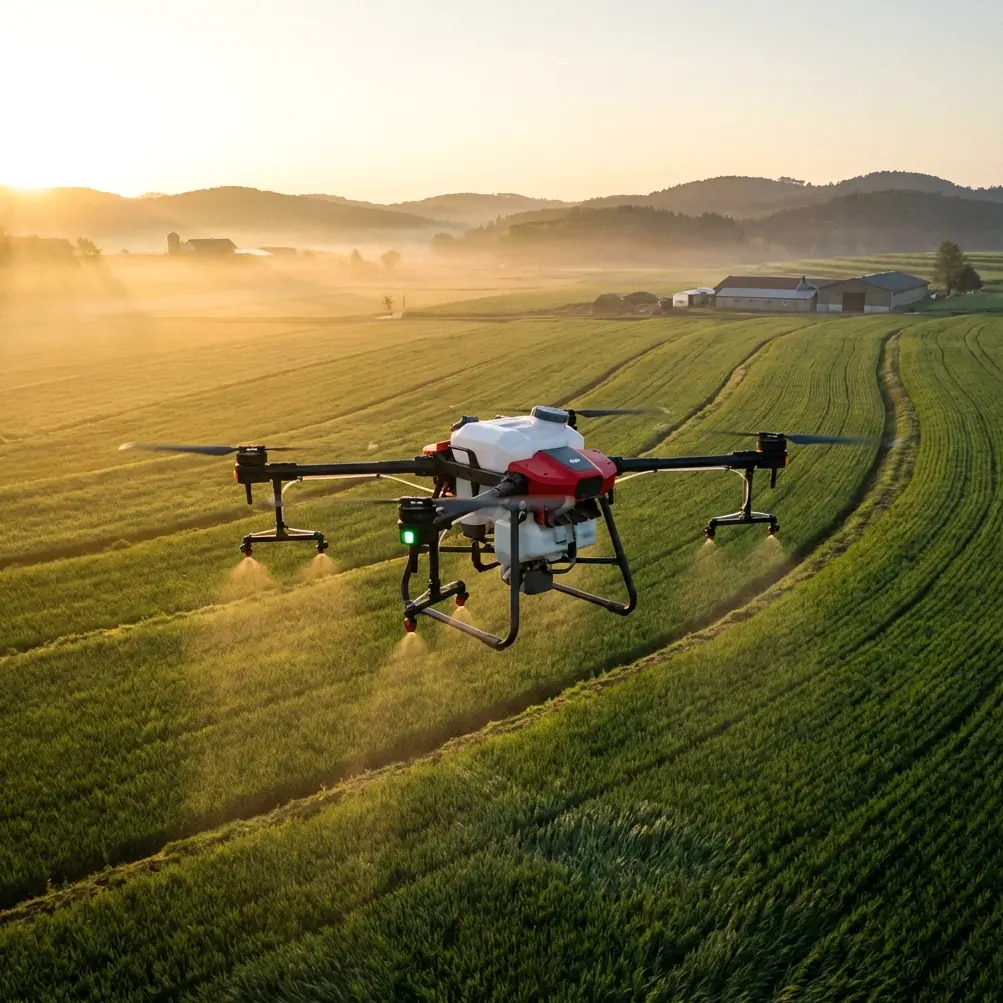
Agras T70P in Dusty Forest Work: A Practical Field Tutorial on Precision, Interference, and Repeatable Flight Discipline
META: A field-focused Agras T70P tutorial for dusty forest operations, covering centimeter precision, RTK stability, antenna adjustment under electromagnetic interference, nozzle calibration, spray drift control, and training workflow.
Forest work exposes every weakness in a drone operation. Dust hangs in the air, tree lines break signals, terrain shifts perception, and a small positioning error can widen into missed coverage or drift beyond the target zone. For teams considering the Agras T70P for demanding agricultural work near wooded areas, the real question is not whether the aircraft looks capable on paper. It is whether the system can hold precision and repeatability when conditions become messy.
That is the right lens for understanding the T70P.
This article is built around a specific operating scenario: dusty forest-edge missions where reliable coverage, stable guidance, and disciplined pilot technique matter more than marketing specs. The Agras T70P sits in a category where swath width, nozzle calibration, RTK fix rate, and antenna behavior are not side notes. They define whether a job is efficient, compliant, and agronomically useful.
Why dusty forest environments are harder than open-field spraying
An open field is forgiving. Forest margins are not.
Dust can obscure visual references during takeoff and landing, coat exposed surfaces, and complicate post-flight inspection. Trees can create irregular airflow and increase the risk of spray drift, especially along edges where canopy gaps channel wind in strange ways. Terrain may also interfere with line-of-sight judgment, making precise low-altitude work harder than it appears from a mission plan.
Then there is the invisible problem: electromagnetic disturbance.
A recent drone incident over Estonia put electronic disruption into public view. Estonian officials said a drone that entered their territory may have deviated because of electronic jamming, and a NATO fighter later shot it down after it crossed into a member state’s airspace. That event was not about agricultural aviation, but it underscores a universal lesson for civilian operators: when a drone loses positional integrity or guidance stability, consequences arrive fast. In commercial operations, the stakes are different, but the principle is identical. Signal resilience and situational awareness are not optional.
For Agras T70P crews working near infrastructure, ridgelines, communications equipment, or dense vegetation, interference management should be part of normal operating discipline, not an afterthought.
Start with precision on the ground, not only in the air
One of the most overlooked truths in UAV operations comes from basic training logic rather than high-end hardware. A training reference for DJI’s educational TT platform describes a simple task: the aircraft lifts from a takeoff area, then completes a fixed-point takeoff and landing routine, with the parking-zone flight height set to just 10 centimeters. That number sounds trivial. It is not.
A 10 cm controlled hover and landing exercise teaches something every serious T70P operator needs: precision begins with repeatable close-in control. Before expecting clean swath placement or dependable edge work in a forest block, crews should be able to launch, stabilize, and recover the aircraft consistently in constrained, dusty ground conditions.
Why does this matter operationally?
Because most mission problems do not start during the middle of a perfect pass. They start at the margins: a rushed setup, a crooked takeoff position, a poor antenna orientation, an unverified RTK state, a nozzle set that was “probably fine” from the previous job. If your team cannot repeat a tight, disciplined start and finish sequence, the rest of the mission inherits that sloppiness.
For the T70P, a smart field routine begins with:
- a clearly marked launch and recovery zone away from loose debris
- a dust check on intakes, sensors, and exposed interfaces
- confirmation of RTK status before committing to productive passes
- a deliberate antenna orientation check, especially near tree lines or reflective structures
- a short low-altitude stability verification before the full route begins
That kind of workflow sounds conservative. It is actually efficient, because it prevents rework.
RTK fix rate is not just a spec sheet talking point
In dusty forest-edge operations, centimeter precision matters only when it is consistently available. That is where RTK fix rate becomes more than a checkbox.
A stable RTK solution supports cleaner path repeatability, especially when you are trying to maintain uniform coverage along irregular boundaries. In practical terms, this affects how accurately the T70P can hold intended lines, avoid unnecessary overlap, and return to a previous section without guesswork. The difference between a solid fix and a degraded positional state can show up as uneven application near canopy edges, inconsistent spacing between passes, or avoidable stress on the operator who starts compensating manually.
The phrase “centimeter precision” gets used loosely in drone marketing. In real field work, it should be treated as a conditional capability. It depends on setup quality, local signal conditions, and operator discipline.
That is where antenna adjustment enters the picture.
Handling electromagnetic interference: antenna adjustment is a field skill, not a last resort
The context for this article specifically highlights electromagnetic interference and antenna adjustment, and that is exactly where many crews can improve.
Forests themselves are not jammers, of course. But dusty forest work often happens near mixed environments: pumping stations, rural power infrastructure, communication towers, work vehicles, and uneven terrain that changes signal geometry. Even without severe interference, suboptimal antenna positioning can reduce link quality and confidence in control or data reception.
A practical T70P habit is to treat antenna setup as part of mission geometry.
That means:
- Position the ground side of the link with a clean line toward the working block whenever possible.
- Avoid standing too close to large metal objects or vehicles during link establishment.
- Reassess antenna angle when moving from open field into tree-adjacent lanes.
- If RTK stability or control quality degrades, pause and troubleshoot orientation before assuming a software issue.
- Record where interference symptoms appear, because the pattern often repeats at the same site.
This is where the Estonia incident offers a civilian lesson without importing its geopolitical context. A drone can depart from expected behavior when electronic conditions change. Agricultural operators do not need dramatic events to respect that fact. They just need one mission where a weak link, poor positioning update, or unstable guidance creates uneven application near a sensitive boundary.
If your team is mapping recurring interference zones around a worksite and wants a practical setup discussion, this direct field chat can help: message our operators on WhatsApp.
Nozzle calibration decides whether precision in flight becomes precision on the crop
Agras operators sometimes focus heavily on route planning and not enough on the liquid delivery side. That is a mistake, especially in dusty conditions where buildup, wear, and subtle flow variation can quietly reduce application quality.
Nozzle calibration is operationally significant because the aircraft can only place material accurately if the delivery system is behaving predictably. Even excellent path tracking will not rescue a mismatched output pattern. In forest-edge work, where airflow is already less uniform, calibration matters even more.
For the T70P, nozzle calibration should be treated as a recurring field discipline rather than a one-time setup task. The goal is not simply to confirm that the system is spraying. The goal is to verify that output consistency matches the mission requirement across the intended swath width.
This affects three things immediately:
- Coverage uniformity: uneven output creates hot and weak zones.
- Spray drift management: droplet behavior becomes harder to predict when the system is not calibrated well.
- Boundary control: poor calibration can push over-application at edges where precision matters most.
In dusty forest conditions, inspect nozzles more often than you would in cleaner open terrain. Fine debris and residue can alter flow characteristics gradually enough that an operator notices only after application quality has already suffered.
Spray drift at the forest edge is a planning problem before it becomes a weather problem
Spray drift is often blamed on wind alone. That is too simplistic.
At a forest boundary, turbulence can be shaped by trunks, canopy gaps, elevation changes, and access roads. Two adjacent passes can behave differently even with similar wind readings. That is why drift control with the T70P should be handled as a systems problem: aircraft speed, altitude, nozzle condition, droplet profile, route orientation, and edge strategy all interact.
Operationally, this means your swath width should not be treated as fixed merely because it worked in an open block earlier in the day. Tree-adjacent work may justify a more conservative approach, tighter observation, and route adjustments based on what the site is actually doing rather than what the mission template assumed.
This is also where multispectral or other crop-analysis workflows can add value around the spraying mission. Not because every T70P operation must become a data-science exercise, but because informed treatment zones reduce unnecessary application and improve confidence that the aircraft is being used precisely where it should be. The less guesswork in defining target areas, the lower the chance of compensating with overly broad treatment margins.
Good T70P operators train like pilots, not button-pushers
One of the strongest lessons in the provided training material has nothing to do with sensors or payload systems. It comes from flight instruction. The source explains that even a simple roll maneuver improves mainly through “after-action reflection,” and that a good instructor sets one training objective before flight, then reviews the result afterward, correcting the most obvious problem first. It also notes that trying to explain everything during the maneuver can distract the student.
That idea translates extremely well to Agras T70P operations.
Aerial application crews often try to fix everything at once during a mission: speed, line spacing, altitude, flow, wind judgment, camera view, recovery timing. The result is usually cognitive overload. A better method is to isolate one improvement target per training block.
For example:
- one sortie focused only on launch and landing consistency in dust
- one sortie focused on antenna orientation and RTK stability checks
- one sortie focused on edge-pass discipline and swath observation
- one sortie focused on nozzle verification and application pattern review
This method works because it creates repeatable learning. It also mirrors the logic from that training reference: first establish the task, then review what happened after the action, then correct the most visible issue. Not all at once. Not while the operator is already saturated.
For T70P teams, that approach can sharply improve reliability in complex sites. It also builds stronger muscle memory for recovery procedures, manual intervention, and cleaner site assessment.
A useful pre-flight tutorial flow for the Agras T70P in dusty forest jobs
If I were structuring a field-ready tutorial for this aircraft and this scenario, it would look like this:
1. Define the mission edge conditions
Do not begin with payload assumptions. Begin with the site. Identify forest boundaries, dust sources, terrain interruptions, and any likely interference points.
2. Prepare a clean launch zone
Take the educational-drone lesson seriously. If a training platform uses a 10 cm parking-zone height to teach precision, your commercial routine should be no less disciplined. A stable launch and recovery area reduces dust ingestion and gives you a repeatable baseline.
3. Confirm positioning quality
Check RTK state before productive work. A poor fix rate near the start of a mission is not something to “see if it improves later.”
4. Set and verify antenna orientation
This is especially relevant when shifting between open access roads and tree-lined corridors. Small adjustments can restore stability more effectively than random troubleshooting.
5. Validate nozzle condition and calibration
Do this before assuming your swath width and application profile are correct.
6. Run a short confidence segment
A brief low-risk pass can reveal drift behavior, control responsiveness, and visibility issues created by dust.
7. Debrief immediately after each segment
Use the training principle from aerobatic instruction: one clear objective, then post-action reflection. Correct the largest error first.
That structure is not glamorous. It is exactly why it works.
The T70P is most valuable when the operation around it is disciplined
The Agras T70P belongs in serious commercial workflows, but the aircraft alone does not create precision. The operation does.
A mission near forests in dusty conditions rewards crews that understand three layers at once: positional integrity, liquid delivery integrity, and training integrity. Positional integrity means respecting RTK performance and interference behavior. Liquid delivery integrity means taking nozzle calibration and spray drift seriously. Training integrity means building habits through repeatable tasks and post-flight reflection rather than improvising under pressure.
Two details from the reference material stand out for exactly this reason. First, the seemingly small 10-centimeter fixed-point takeoff and landing exercise shows how fine control at the ground interface builds reliability for the whole mission. Second, the training doctrine of setting one goal before flight and reviewing the result afterward offers a far better path to T70P proficiency than trying to correct every variable in real time.
Add the broader lesson from the Estonia drone deviation case — that electronic disruption can push aircraft behavior off its intended path — and one conclusion becomes clear: even in civilian agricultural operations, signal awareness and procedural rigor are part of safe productivity.
That is how to think about the Agras T70P in dusty forest work. Not as a generic spraying machine, and not as a showcase for isolated specs, but as a precision tool whose real performance emerges only when the crew matches the platform with disciplined fieldcraft.
Ready for your own Agras T70P? Contact our team for expert consultation.