
Agras T70P Delivering Tips for Mountain Vineyards
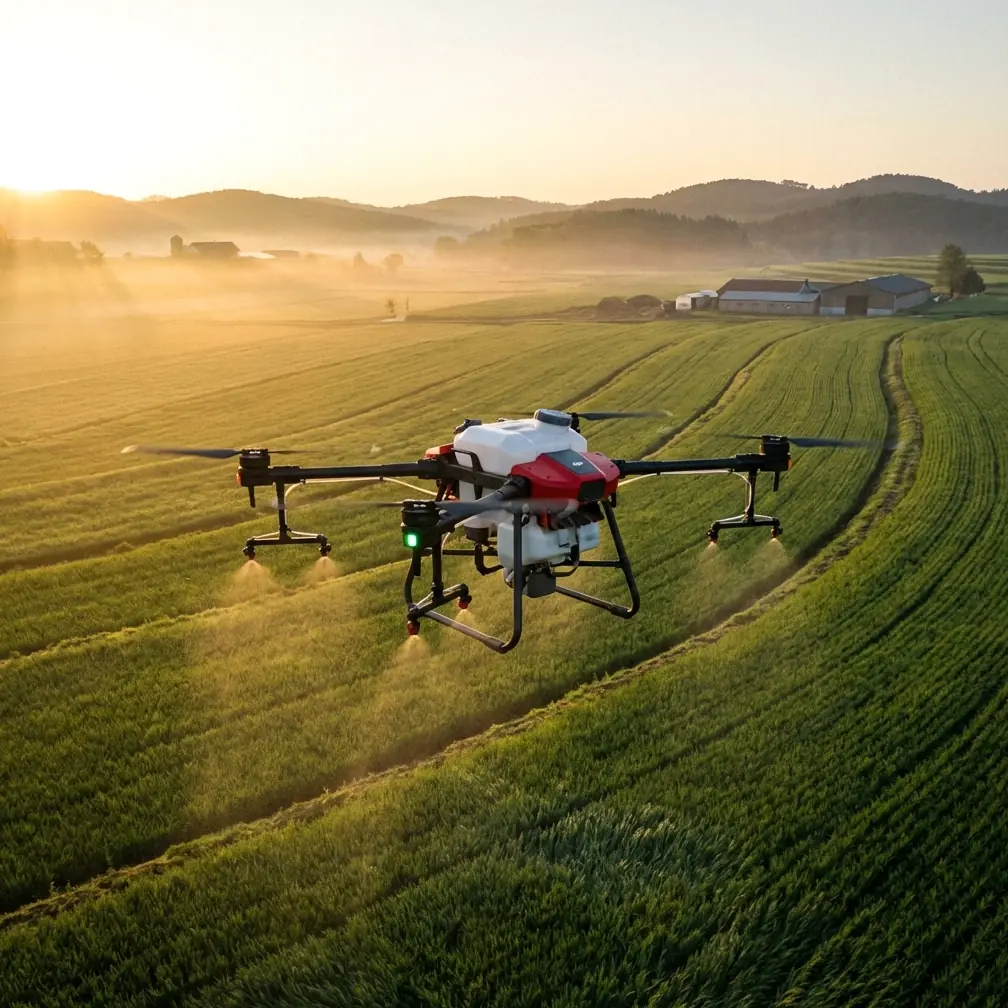
Agras T70P Delivering Tips for Mountain Vineyards: What Actually Matters on Steep, Tight Terrain
META: Practical Agras T70P advice for mountain vineyards, with expert insight on spray drift, nozzle calibration, RTK fix rate, swath width, IPX6K durability, and precision flying on steep slopes.
Mountain vineyards punish bad assumptions. A spray plan that works on flat row crops can fall apart the moment the terrain tilts, the wind starts curling through a narrow valley, and the rows squeeze between rock walls, terraces, and access roads that barely fit a pickup. That is exactly where the Agras T70P becomes interesting—not because it promises magic, but because the right aircraft setup can remove several of the operational headaches that used to cost crews time, chemistry, and confidence.
I’ve spent enough time around steep vineyards to know the pattern. The first challenge is never just payload or battery time. It is control. You are trying to hold a consistent application over vines that do not present a neat, flat target. Canopy density changes from block to block. Row spacing shifts. Gusts roll uphill in one section and drop sideways across the next. If your aircraft cannot maintain reliable positioning and repeatable pass geometry, your “coverage” starts turning into a guess.
That is why the T70P matters most in mountain work when it is treated as a precision tool, not simply a larger spraying platform. Readers looking at this model for vineyard delivery should focus less on headline capability and more on how its practical features help solve three stubborn field problems: drift control, repeatability on irregular terrain, and day-after-day reliability in dirty, wet operating conditions.
The first problem is spray drift, and mountain vineyards are especially vulnerable to it. In flat fields, drift is often discussed as a weather variable. In hills, it becomes a terrain variable too. Airflow wraps around slopes, accelerates through gaps, and lingers unexpectedly near the edge of terraces. This is where nozzle calibration becomes more than a maintenance task. It becomes the difference between a targeted treatment and a cloud of wasted product moving into non-target areas.
With the T70P, nozzle calibration should be treated as a pre-mission discipline, not an occasional check. The practical reason is simple: the aircraft can only execute a high-quality route if the liquid system is matched to the crop, the droplet target, and the flight profile. If a pilot is flying a wider swath width than the canopy can realistically accept, or using a droplet profile too fine for the morning’s wind behavior, the drone may still fly beautifully while the application quality quietly degrades. In mountain vineyards, that hidden mismatch shows up fast—usually as inconsistent deposition on the downwind side of rows or excess movement beyond the canopy edge.
I remember a job on a steep vineyard block where the rows curved around a ridge and dropped sharply toward a drainage cut. The crew had decent equipment, but they were treating the route as the whole mission. It wasn’t. Their biggest issue was that the application pattern changed as the aircraft crossed from a sheltered band into exposed air on the outer edge. We tightened the swath width, changed the nozzle setup, and adjusted pass logic to match the terrain instead of forcing the terrain to fit the software. The difference was immediate. Less correction. More confidence. Better visual consistency in coverage. That is the lens I would use with the Agras T70P in mountain vineyards: not “How much can it carry?” but “How precisely can it repeat a smart plan under variable conditions?”
Centimeter precision is another phrase that gets thrown around too casually. In vineyard work, especially on mountain sites, it has real operational value. A strong RTK fix rate is not just about prettier maps or cleaner tracks on the controller screen. It directly affects how confidently the aircraft can hold its lines along narrow rows, terraces, and edges where a small lateral deviation matters. In a broadacre field, drifting half a meter might be annoying. In a mountain vineyard, it can mean clipping into canopy where you did not intend to, overapplying the uphill edge, or under-serving a strip that is already difficult for ground crews to reach.
That makes RTK fix stability one of the most overlooked performance indicators for T70P operators. If your fix rate is inconsistent because of terrain masking, poor base station placement, or signal interruption from surrounding topography, application quality suffers even before a pilot notices it visually. The route starts to feel less “locked in.” Overlap patterns become messier. Efficiency drops because the operator has to supervise corrections instead of letting the mission run with confidence. For vineyards in mountain corridors, I would argue that RTK discipline is as important as battery logistics. Before a demanding block, validate the fix quality from takeoff area to the farthest treatment edge. That small habit can prevent a long list of expensive little errors.
Then there is swath width, one of the most misunderstood numbers in drone spraying. Operators often treat it as a productivity setting. In vineyards, it is really a canopy matching decision. The wider the swath, the more productivity you may gain on paper, but mountain vineyards rarely reward paper efficiency. They reward placement. A narrower, more controlled swath often produces better real-world outcomes because it respects row structure, airflow, and variable canopy height. The T70P gives you the kind of platform where that tuning matters. If you use it with discipline, you can shape operations to fit the site rather than defaulting to one broad setting across every block.
This becomes especially useful where delivery missions overlap with crop protection routines. Many vineyard managers are no longer interested in drones as single-purpose tools. They want one aerial system that helps with application, difficult-area access, and data-driven decision making. That is where multispectral planning enters the conversation. Not every T70P deployment will be tied directly to multispectral imaging, but the operational link is powerful: identify variability first, then fly the treatment mission with narrower assumptions and better timing. In mountain vineyards, where vigor can shift sharply across slope, aspect, and elevation, that connection matters. If one block is under stress on the upper terrace while the lower rows hold more moisture and denser growth, a generic blanket plan wastes time. A data-informed T70P operation lets the crew respond with more precision.
That precision also reduces friction with the people who actually have to live with the results. Vineyard owners care about coverage, yes, but they also care about drift near roads, neighboring plots, worker safety, and whether the aircraft can operate reliably after a muddy morning or a sudden burst of rain. That is where durability stops being a brochure detail. An IPX6K-rated platform matters in real field conditions because mountain vineyard operations are rarely clean, controlled, or predictable. Spray residue builds up. Dust sticks to wet surfaces. Washdown happens often. Equipment gets loaded and reloaded on uneven ground. A system that tolerates aggressive water exposure and messy workflows is easier to keep mission-ready through the busiest parts of the season.
I put that in the category of “quiet value.” It does not always get the headline, but it affects uptime. And uptime is what determines whether a vineyard team sees drone adoption as progress or just another layer of complexity. If the T70P can be cleaned quickly, turned around efficiently, and sent back out with confidence, it fits the rhythm of mountain operations much better than a machine that demands overly delicate handling after every sortie.
There is also the delivery side of the equation, which often gets overshadowed by spray talk. In steep vineyards, moving materials is not trivial. Narrow tracks, elevation changes, and awkward access points mean simple tasks become slow tasks. A drone like the T70P is valuable when it reduces the number of risky or repetitive manual movements into difficult terrain. But this only works if the mission planning accounts for real obstacles, wind channels, and landing or drop logistics. Too many operators think of aerial delivery as a straight-line shortcut. In hills, it is a choreography problem. The route has to be safe, predictable, and repeatable, especially when the receiving point sits on uneven ground or near vine structures.
The lesson from past projects is that mountain vineyards reward conservative planning and punish overconfidence. If you are preparing a T70P for this kind of environment, do not start with maximum settings. Start with the block’s hardest section. Measure where the airflow shifts. Check the RTK behavior under partial sky obstruction. Confirm nozzle calibration with the actual liquid profile you will use, not the one that happened to be in the machine last week. Reassess swath width according to canopy geometry, not just throughput targets. And keep the cleaning routine tight because IPX6K helps, but only if the operator treats maintenance as part of application quality.
For teams still deciding whether the T70P fits their vineyard reality, the right question is not whether it can fly the mission. It can. The real question is whether your operation is ready to use its precision properly. Mountain vineyards create a narrow margin between a well-executed sortie and an expensive compromise. The T70P narrows that gap when paired with disciplined setup and terrain-aware planning.
If you are building out a flight workflow for a difficult block and want a second set of eyes, you can message me here. Sometimes one adjustment to route logic or droplet strategy saves a whole day of trial and error.
What I like about the Agras T70P in this context is that it makes a hard job more manageable without pretending the mountain disappears. It still asks for judgment. It still rewards experienced operators who understand canopy behavior, weather windows, and positional integrity. But compared with older workflows that relied heavily on manual access, rough assumptions, and reactive correction, this model gives vineyard teams a cleaner way to execute. Better placement. Better repeatability. Fewer compromises forced by slope and access.
For mountain vineyards, that is the difference that matters. Not hype. Not abstract specs. Just a machine that, when set up correctly, lets you work with the terrain instead of constantly fighting it.
Ready for your own Agras T70P? Contact our team for expert consultation.