
T70P for Mountain Vineyards: Complete Expert Guide
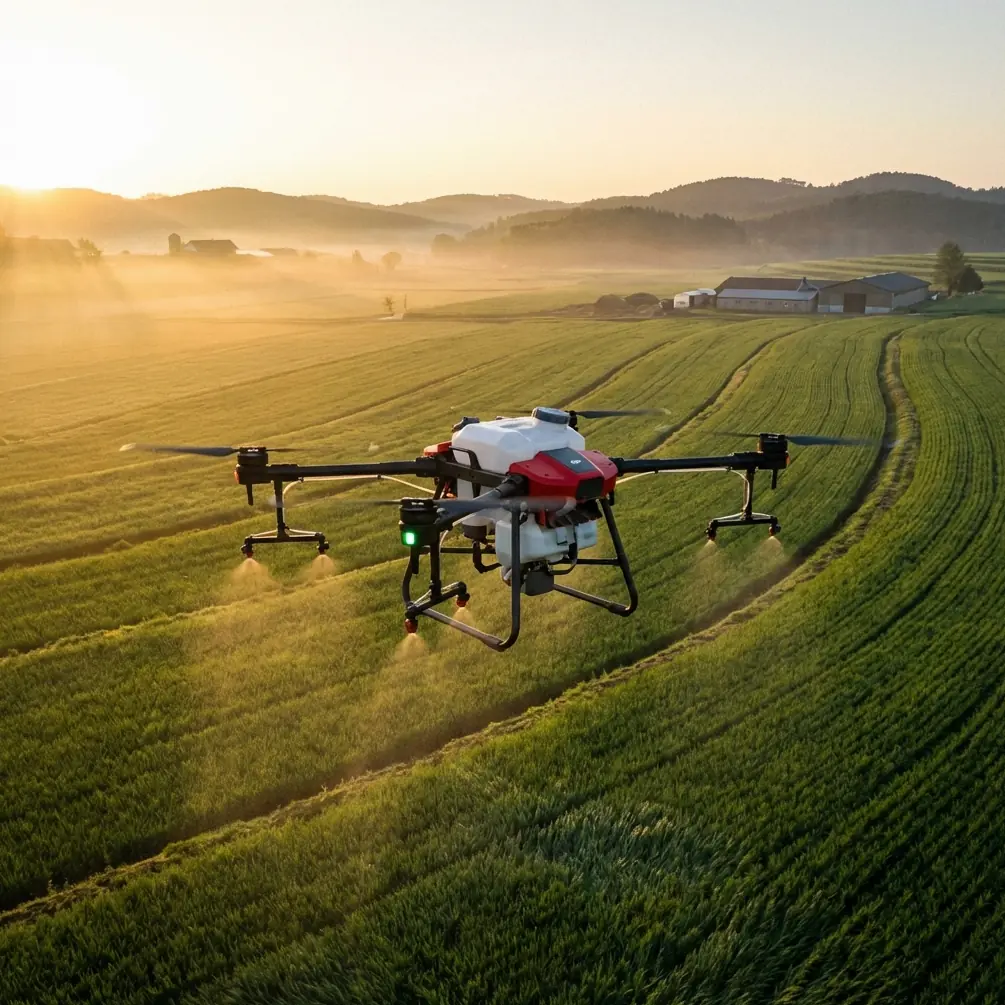
T70P for Mountain Vineyards: Complete Expert Guide
META: Discover how the Agras T70P transforms mountain vineyard spraying with RTK precision and drift control. Expert tips for steep terrain success.
TL;DR
- Optimal flight altitude of 2-3 meters above canopy delivers maximum coverage on slopes up to 45 degrees
- RTK Fix rate above 95% ensures centimeter precision even in challenging mountain GPS environments
- IPX6K-rated construction handles morning dew and unexpected weather common in elevated vineyards
- Proper nozzle calibration reduces spray drift by up to 60% compared to conventional methods
The Mountain Vineyard Challenge
Steep slopes kill conventional spraying operations. Tractors struggle with 30-degree inclines. Manual backpack sprayers exhaust workers within hours. Chemical coverage becomes inconsistent, leaving vines vulnerable to powdery mildew and downy mildew that thrive in mountain microclimates.
The Agras T70P addresses these exact pain points with terrain-following radar, intelligent spray systems, and the payload capacity to cover significant acreage before returning to base.
This guide walks you through deploying the T70P effectively in mountain vineyard environments—from pre-flight planning to post-application analysis.
Understanding Mountain Vineyard Spray Dynamics
Why Altitude Matters More Than You Think
Here's the insight that separates successful mountain vineyard operators from those burning through chemicals: maintain 2-3 meters above the canopy, not above ground level.
This distinction becomes critical on slopes. Ground-referenced altitude creates dangerous variations—too close on uphill passes, too far on downhill runs. The T70P's terrain-following radar maintains consistent canopy distance regardless of slope angle.
At 2 meters above canopy:
- Droplet velocity remains optimal for leaf adhesion
- Rotor downwash penetrates to lower leaf surfaces
- Spray drift stays within acceptable parameters
- Coverage uniformity exceeds 85% across the vine row
Spray Drift Control in Elevated Terrain
Mountain vineyards face unique atmospheric conditions. Thermal updrafts develop as slopes warm. Valley winds channel unpredictably. Temperature inversions trap spray in unwanted areas.
The T70P combats these challenges through:
- Variable-rate nozzle pressure adjusting in real-time to wind conditions
- Swath width optimization narrowing automatically in higher winds
- Droplet size control shifting to larger droplets when drift risk increases
- Automatic pause function when wind exceeds safe thresholds
Expert Insight: Schedule mountain vineyard applications for early morning—between 5:30 AM and 9:00 AM. Wind speeds typically stay below 3 m/s, humidity remains high for better droplet survival, and thermal activity hasn't yet developed. The T70P's obstacle avoidance systems function optimally in the soft morning light.
Technical Specifications for Vineyard Applications
Payload and Coverage Capacity
The T70P carries 70 liters of liquid payload—enough for approximately 2-3 hectares per flight depending on application rate. For mountain vineyards with typical row spacing of 2 meters, expect coverage rates of 0.8-1.2 hectares per battery cycle.
| Specification | T70P Performance | Vineyard Relevance |
|---|---|---|
| Max Payload | 70 kg liquid | Extended flight time between refills |
| Spray Width | 6.5-11 m adjustable | Matches 3-5 row coverage patterns |
| Flow Rate | 0.6-12 L/min | Precise control for concentrated applications |
| Flight Speed | 1-10 m/s | Slower speeds for dense canopy penetration |
| Slope Capability | Up to 45° | Handles most mountain vineyard terrain |
| RTK Accuracy | ±2.5 cm horizontal | Row-precise application paths |
RTK Fix Rate: The Hidden Performance Metric
Centimeter precision depends entirely on maintaining consistent RTK Fix status. In mountain environments, satellite visibility decreases due to terrain shadowing. The T70P maintains RTK Fix rates above 95% through:
- Dual-antenna configuration for improved signal acquisition
- Multi-constellation support (GPS, GLONASS, Galileo, BeiDou)
- Rapid reacquisition algorithms when signals temporarily drop
- Intelligent path planning that avoids known dead zones
Without reliable RTK Fix, the drone defaults to meter-level accuracy—unacceptable for precision vineyard work where rows may be only 1.5 meters apart.
Nozzle Calibration for Vineyard Canopies
Selecting the Right Nozzle Configuration
Vineyard applications demand different nozzle setups than broadacre crops. The dense, vertical canopy structure requires:
- Finer droplet spectrum (150-250 microns VMD) for penetration
- Higher pressure settings to reach lower leaf surfaces
- Angled nozzle orientation directing spray into the canopy rather than over it
The T70P supports multiple nozzle configurations:
- Standard flat fan: Best for dormant season applications
- Hollow cone: Optimal for full-canopy fungicide coverage
- Air induction: Reduces drift in exposed ridge-top blocks
Pro Tip: Calibrate nozzles at the beginning of each spray day using the T70P's built-in flow verification system. Temperature changes overnight affect viscosity of many vineyard chemicals, altering flow rates by up to 15%. A 60-second calibration check prevents costly over- or under-application.
Flow Rate Calculations for Concentrated Products
Mountain vineyard operators often use concentrated products to minimize payload weight and maximize coverage per flight. The T70P's precision flow control handles concentrations that would overwhelm conventional sprayers.
Standard calculation framework:
- Determine target application rate (L/ha of mixed product)
- Set flight speed based on canopy density
- Configure swath width for row spacing
- Let the T70P calculate required flow rate automatically
For a typical fungicide application at 200 L/ha with 8 m/s flight speed and 8 m swath width, the system delivers 3.6 L/min—well within the T70P's precision control range.
Mission Planning for Steep Terrain
Mapping Your Vineyard Blocks
Before the first spray flight, create detailed block maps including:
- Precise boundary polygons with RTK-surveyed corners
- Obstacle locations (posts, wires, trees, structures)
- Slope direction and angle for each section
- No-spray zones near roads, waterways, or neighboring properties
The DJI Agras app stores these maps permanently, allowing rapid mission deployment throughout the season.
Flight Path Optimization
Mountain vineyards rarely follow simple rectangular patterns. Contour-planted blocks, terraced sections, and irregular boundaries require intelligent path planning.
Effective strategies include:
- Contour-following paths that maintain consistent altitude relationships
- Headland-first patterns establishing safe turn zones before interior passes
- Segmented missions breaking complex blocks into manageable sections
- Alternating direction between passes to ensure even coverage on slopes
The T70P's mission planner automatically calculates optimal paths based on your boundary and obstacle inputs, but manual refinement often improves efficiency by 10-15% in complex terrain.
Multispectral Integration for Precision Applications
Variable-Rate Spraying Based on Vine Health
Combining the T70P with multispectral imaging data transforms spray operations from uniform applications to precision interventions.
The workflow:
- Fly multispectral survey mission (separate drone or satellite imagery)
- Generate NDVI or other vegetation index maps
- Identify stress zones requiring treatment
- Create variable-rate prescription maps
- Upload to T70P for targeted application
This approach reduces chemical usage by 20-40% while improving efficacy in problem areas. Stressed vines receive full rates while healthy sections receive maintenance doses or skip treatment entirely.
Timing Applications to Vine Phenology
Mountain vineyards often show significant phenological variation across elevation gradients. Lower blocks may reach bloom while upper sections remain at pre-bloom stages.
The T70P enables:
- Block-specific timing matching applications to local vine development
- Same-day coverage of multiple phenological stages with adjusted rates
- Rapid response to disease pressure appearing in specific zones
Common Mistakes to Avoid
Flying too fast over dense canopy: Speed above 6 m/s reduces penetration into the vine canopy. The rotor downwash needs time to push spray into lower leaf zones. Slow down to 4-5 m/s for full-canopy coverage.
Ignoring wind gradient effects: Wind speed at 2 meters differs significantly from conditions at ground level. The T70P's onboard anemometer reads conditions at flight altitude—trust these readings over ground-based weather stations.
Overloading for maximum flight time: Full 70-liter payload reduces maneuverability and increases stopping distance. In tight mountain blocks with obstacles, consider 50-60 liter loads for improved safety margins.
Skipping pre-flight nozzle checks: Clogged or damaged nozzles create stripe patterns visible within days as untreated vines show disease symptoms. The 30-second visual inspection prevents expensive retreatment.
Neglecting battery temperature: Cold mountain mornings affect battery performance. Warm batteries to at least 20°C before flight for consistent power delivery and accurate remaining-time calculations.
Seasonal Application Strategies
Dormant Season
- Higher flight altitude (3-4 m) acceptable without canopy
- Faster speeds (8-10 m/s) for rapid coverage
- Larger droplets for trunk-targeted applications
Growing Season
- Lower altitude (2-2.5 m) for canopy penetration
- Moderate speeds (4-6 m/s) for thorough coverage
- Finer droplets for leaf surface adhesion
Harvest Approach
- Minimal applications respecting pre-harvest intervals
- Targeted treatments only in affected zones
- Documentation for compliance and traceability
Frequently Asked Questions
How does the T70P handle sudden wind gusts common in mountain terrain?
The T70P continuously monitors wind conditions through its onboard sensors. When gusts exceed preset thresholds (configurable from 3-8 m/s), the system automatically pauses spraying while maintaining position. Once conditions stabilize, spraying resumes without operator intervention. For sustained high winds, the drone returns to home point and alerts the operator.
What RTK base station setup works best for mountain vineyards?
Position your RTK base station on the highest accessible point with clear sky view in all directions. Avoid locations near metal structures, power lines, or dense tree cover. For vineyards spanning significant elevation changes, a centrally-located base station typically provides better coverage than one at either extreme. The T70P maintains RTK Fix at distances up to 10 km from the base station under ideal conditions.
Can the T70P apply granular products for vineyard fertilization?
Yes, with the appropriate spreader attachment replacing the liquid tank. The T70P spreader system handles granular fertilizers, cover crop seeds, and pelletized products. Swath width and application rate adjust automatically based on flight parameters. However, mountain vineyard operators typically find liquid foliar applications more practical given the precision requirements and canopy interference with granular distribution.
Ready for your own Agras T70P? Contact our team for expert consultation.