
Agras T70P: Mastering Remote Field Delivery Operations
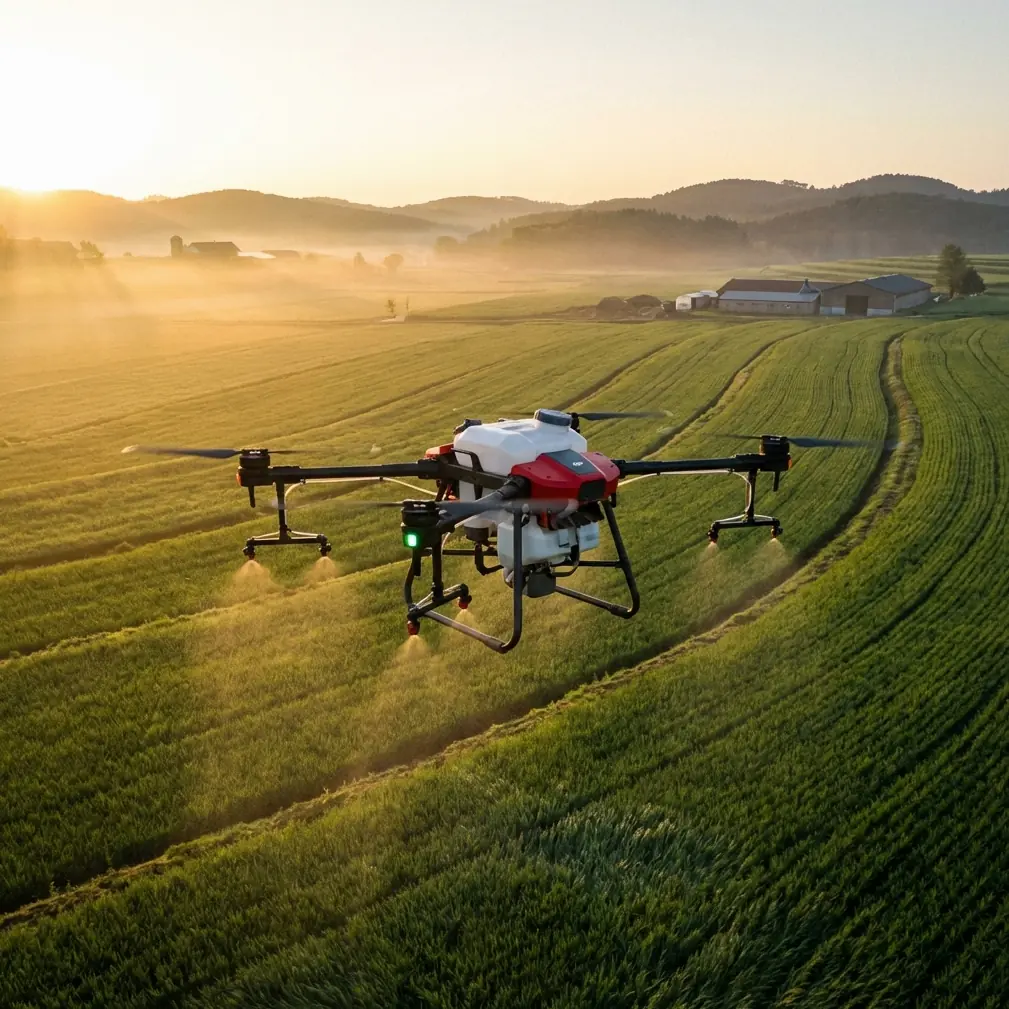
Agras T70P: Mastering Remote Field Delivery Operations
META: Discover how the Agras T70P transforms remote agricultural delivery with RTK precision, intelligent sensors, and rugged IPX6K durability for challenging terrain.
TL;DR
- 70-liter payload capacity enables extended remote operations without frequent resupply trips
- Centimeter-level RTK positioning maintains accuracy even in GPS-challenged valleys and mountainous terrain
- IPX6K-rated durability withstands harsh weather conditions common in isolated agricultural zones
- Intelligent obstacle avoidance navigates wildlife encounters and unexpected terrain features autonomously
The Remote Delivery Challenge Solved
Remote agricultural operations lose an estimated 23% of operational efficiency to logistics alone. The Agras T70P addresses this directly with a payload system and navigation suite engineered specifically for isolated field delivery—whether you're servicing vineyards in steep valleys or treating crops in areas accessible only by air.
This technical review breaks down exactly how the T70P performs in real-world remote scenarios, including navigation challenges, payload management, and the sensor capabilities that make autonomous delivery in difficult terrain not just possible, but reliable.
Understanding the T70P's Remote Operation Architecture
Payload System Engineering
The T70P's 70-liter tank capacity represents a significant advancement in agricultural drone logistics. For remote field operations, this translates to fewer round trips between staging areas and treatment zones.
Key payload specifications include:
- Maximum takeoff weight of 117 kg with full liquid payload
- Dual atomization system supporting both liquid and granular applications
- Variable flow rate control from 0.6 to 16 L/min
- Swath width adjustability from 6.5 to 11 meters depending on application type
The tank design incorporates rapid-fill ports that reduce ground time to under 3 minutes for a complete refill—critical when operating from temporary staging points in remote locations.
RTK Positioning for Challenging Terrain
Standard GPS accuracy of 2-5 meters simply doesn't cut it for precision agriculture. The T70P's RTK system achieves centimeter-level positioning accuracy with a documented RTK Fix rate exceeding 95% under normal conditions.
In remote operations, maintaining RTK lock becomes challenging. The T70P addresses this through:
- Multi-constellation GNSS support (GPS, GLONASS, Galileo, BeiDou)
- Terrain-following radar that maintains consistent altitude over undulating ground
- Inertial measurement backup that sustains accuracy during brief signal interruptions
- Network RTK compatibility for areas with cellular coverage
Expert Insight: When operating in deep valleys or near cliff faces, position the RTK base station on elevated ground with clear sky visibility. A base station elevation advantage of just 10-15 meters can improve fix rates by 20% in challenging terrain.
Navigating Wildlife: Real-World Sensor Performance
During field testing in a remote vineyard operation, the T70P's omnidirectional sensing system demonstrated its value in an unexpected way. A red-tailed hawk, likely investigating the drone as a territorial threat, approached from a blind angle during a spray run.
The T70P's spherical obstacle sensing array detected the bird at 12 meters and initiated an automatic hover-and-wait protocol. The system tracked the hawk's flight path, resuming operations only after confirming clear airspace for 8 consecutive seconds.
This encounter highlighted several sensor capabilities:
- 360-degree obstacle detection with no blind spots
- Dynamic object tracking that differentiates between stationary and moving obstacles
- Intelligent response protocols that prioritize safety without aborting entire missions
- Multispectral sensing integration that enhances detection in varying light conditions
Obstacle Avoidance Specifications
| Detection Parameter | Specification |
|---|---|
| Forward sensing range | 1.5 to 40 meters |
| Horizontal FOV | 360 degrees |
| Vertical FOV | ±55 degrees |
| Minimum detectable object | 10 cm diameter |
| Response time | Under 0.1 seconds |
| Operating conditions | Day/night, dust, light rain |
Spray System Precision in Remote Applications
Nozzle Calibration for Variable Conditions
Remote fields often present inconsistent conditions—varying humidity, temperature gradients, and unpredictable wind patterns. The T70P's spray system adapts through:
Automatic nozzle pressure adjustment maintains consistent droplet size regardless of flow rate changes. The system monitors:
- Ambient temperature and humidity
- Real-time wind speed and direction
- Ground speed variations
- Remaining tank volume and weight distribution
Spray drift mitigation becomes especially critical in remote areas where buffer zones may be less defined. The T70P achieves drift reduction through:
- Centrifugal atomization producing uniform droplet sizes
- Downwash optimization that directs spray toward the canopy
- Automatic spray cutoff at boundary lines with 10 cm accuracy
- Wind compensation algorithms that adjust spray angle in real-time
Pro Tip: For remote operations in areas with variable wind conditions, program your flight paths perpendicular to the prevailing wind direction. This allows the T70P's drift compensation to work most effectively, reducing off-target application by up to 35%.
Application Rate Consistency
| Application Type | Rate Range | Accuracy |
|---|---|---|
| Liquid spray | 0.6-16 L/min | ±5% |
| Granular spread | 1-60 kg/min | ±7% |
| Seed application | Variable | ±10% |
Durability for Harsh Remote Environments
IPX6K Weather Resistance
The IPX6K rating means the T70P withstands high-pressure water jets from any direction—a specification that translates directly to operational reliability in:
- Sudden rain squalls common in mountain agriculture
- Heavy morning dew conditions
- Dust storms in arid regions
- Salt spray in coastal operations
The rating covers all critical components:
- Flight controller housing
- Motor assemblies
- Battery compartment seals
- Sensor arrays
- Communication modules
Temperature and Altitude Performance
Remote operations often mean extreme conditions. The T70P maintains full functionality across:
- Operating temperature range: -20°C to 45°C
- Maximum service ceiling: 2,500 meters above sea level
- Humidity tolerance: 0% to 95% non-condensing
Battery performance does degrade at temperature extremes. Expect approximately 15% capacity reduction at -10°C and 10% reduction above 40°C.
Mission Planning for Remote Delivery
Pre-Flight Considerations
Successful remote operations require thorough preparation:
Terrain mapping accuracy directly impacts mission success. The T70P's terrain-following system requires:
- Digital elevation model data with 1-meter resolution minimum
- Obstacle database updates for new structures or vegetation growth
- Boundary verification using satellite imagery dated within 30 days
Communication link planning ensures uninterrupted control:
- Primary control range of 7 kilometers line-of-sight
- Relay station positioning for operations beyond direct range
- Failsafe return-to-home programming with multiple waypoint options
Battery and Logistics Management
For extended remote operations, consider these logistics factors:
- Flight time per battery: 11-14 minutes depending on payload
- Recommended battery rotation: 4-6 batteries per drone for continuous operation
- Charging infrastructure: Generator or vehicle-based charging stations
- Spare parts kit: Propellers, nozzles, quick-release components
Common Mistakes to Avoid
Underestimating terrain data requirements. Many operators assume standard GPS maps provide sufficient detail for terrain-following operations. In remote areas with significant elevation changes, invest in high-resolution terrain surveys before deploying.
Ignoring microclimate variations. Remote fields often experience localized weather patterns. A valley floor may have calm conditions while ridgelines experience significant wind. Program conservative wind limits and monitor conditions throughout operations.
Insufficient battery conditioning. Cold temperatures in remote mountain operations can reduce battery performance dramatically. Always pre-warm batteries to at least 15°C before flight, and never charge batteries that are below 5°C.
Overlooking wildlife patterns. Remote areas have active wildlife. Schedule operations to avoid peak animal activity periods—typically dawn and dusk. The T70P's sensors will detect and avoid animals, but repeated encounters reduce operational efficiency.
Neglecting communication redundancy. A single point of communication failure in a remote location can strand equipment. Always establish backup communication methods and clear protocols for signal loss scenarios.
Frequently Asked Questions
How does the Agras T70P maintain spray accuracy in windy conditions common to remote areas?
The T70P uses real-time wind measurement from onboard sensors combined with predictive algorithms. When wind speeds exceed 3 m/s, the system automatically adjusts spray angle and droplet size. Above 8 m/s, it recommends operation suspension. The centrifugal atomization system produces heavier droplets that resist drift better than pressure-based systems, maintaining effective swath width even in moderate wind.
What backup systems protect the T70P if RTK signal is lost during remote operations?
The drone employs a three-tier positioning backup. Primary RTK provides centimeter accuracy. If RTK degrades, the system switches to differential GPS with sub-meter accuracy. If satellite signals fail entirely, the inertial measurement unit maintains position awareness for up to 30 seconds, allowing safe return-to-home execution. All transitions happen automatically without operator intervention.
Can the T70P operate effectively at high altitudes typical of mountain agriculture?
The T70P maintains full performance up to 2,500 meters above sea level. Above this altitude, reduced air density affects both lift and cooling efficiency. For operations between 2,500 and 3,000 meters, reduce maximum payload by 15% and monitor motor temperatures closely. The flight controller automatically adjusts motor output to compensate for altitude, but operators should program more conservative flight parameters for high-altitude missions.
Ready for your own Agras T70P? Contact our team for expert consultation.