
Agras T70P for Highway Work in Complex Terrain
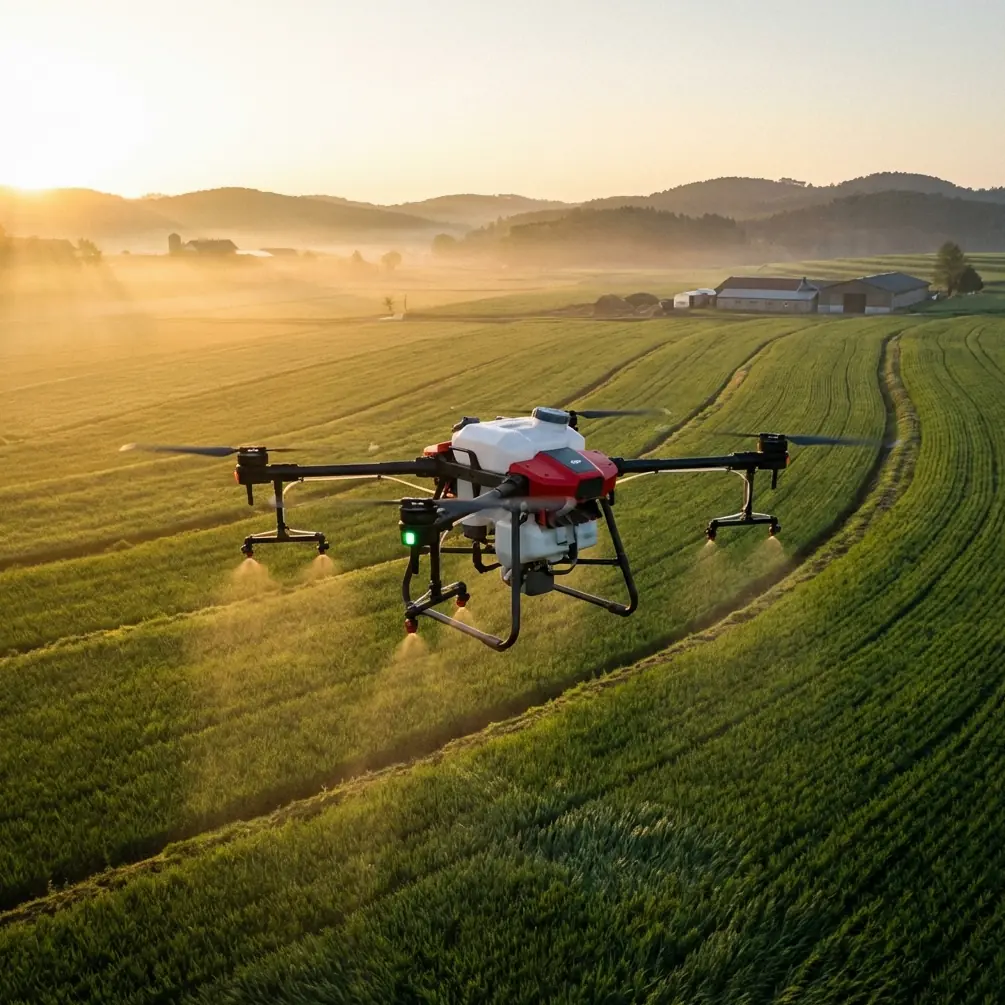
Agras T70P for Highway Work in Complex Terrain: What Actually Matters in the Field
META: Expert analysis of using the Agras T70P around highways in complex terrain, with practical insight on flight altitude, RTK stability, spray drift control, nozzle calibration, and why low-altitude airspace operations now matter more than many operators realize.
Highway corridors look straightforward on a map. In reality, they are some of the most demanding environments a spray or utility UAV operator will face.
The terrain changes fast. Wind behaves differently on cut slopes, embankments, bridge approaches, and median strips. GNSS quality can vary near retaining walls, overpasses, service tunnels, and mountain-adjacent corridors. Add tight operating windows and the pressure rises quickly. When the platform in question is the Agras T70P, the real conversation is not about headline capability alone. It is about whether the aircraft can hold a stable, predictable, safe working pattern when the corridor itself keeps trying to break that pattern.
That is where this discussion gets practical.
The more interesting signal in the current market is not just hardware. It is the surrounding airspace ecosystem. A recent item from UAVCN reported that the Sichuan Low-Altitude Airspace Operation Service Center is recruiting, and the headline makes a point of saying the roles come with formal establishment status. Even though the article summary does not disclose positions, hiring numbers, or deadlines, that detail still matters. It suggests low-altitude operational services are being treated as permanent infrastructure rather than a temporary experiment. For anyone planning highway-facing UAV work with an aircraft like the Agras T70P, that is more than bureaucratic noise. It points to a future where route planning, corridor coordination, and compliant operations in difficult airspace become a bigger competitive advantage than raw airframe specs.
That trend should shape how operators think about the T70P in complex terrain.
The real problem on highways is not distance. It is consistency.
A long highway segment may tempt teams to focus on coverage rate first. That is usually the wrong starting point.
In complex terrain, the weak link is often consistency of application or collection quality from one pass to the next. A slope-side section can generate different airflow than a flat median. A bridge approach may create crosswinds. A mountain cut can cause turbulence that widens droplet spread on one edge and starves the target area on the other. If your flight pattern remains mathematically neat while the environment changes physically every few hundred meters, the job may look complete in the logs and still be poor in reality.
This is why spray drift deserves more attention than speed in highway-adjacent work. Drift is not just product loss. It can become an operational boundary issue near lanes, drainage systems, roadside plantings, barriers, and non-target surfaces. On a corridor job, the cost of drift compounds because the geometry is narrow and linear. There is less forgiveness than in a broad, open field.
For the T70P operator, this means setup discipline matters before lift-off. Nozzle calibration should not be treated as a routine checkbox. In highway work, it determines whether the aircraft can maintain a controlled, repeatable spray profile when terrain and wind shear change between sections. A calibrated system gives the pilot or mission planner a baseline. Without that baseline, every environmental shift gets amplified.
Optimal flight altitude is lower than many crews assume
If the mission is roadside vegetation treatment, shoulder-edge management, or slope-face application near a highway in mixed terrain, the instinct to climb for safety margin often creates the opposite outcome.
A practical working principle is this: fly as low as the surface variability safely allows while maintaining obstacle clearance and stable flow over the target. In many corridor scenarios, that means resisting the urge to add height just because the terrain feels visually complex.
Why? Because every extra meter can enlarge drift exposure, weaken deposition accuracy, and reduce consistency at the edge of the swath. Near roads, where treatment bands can be narrow and irregular, the relationship between altitude and control becomes unforgiving. If the aircraft is too high, the apparent gain in coverage can be offset by weak target contact and more spray movement off line.
For the Agras T70P, a sensible strategy in complex highway terrain is to establish altitude by micro-section, not by corridor average. Flat medians, outer shoulders, drainage margins, and cut slopes should not automatically share one height profile. If the aircraft and mission logic allow adaptive terrain following, use that advantage carefully. If not, break the route into shorter operating blocks. That creates a tighter match between swath width and actual target geometry.
The goal is not simply low altitude. It is the lowest altitude that preserves control, obstacle safety, and a clean application window.
That distinction matters.
Centimeter-level positioning only helps if the fix is stable
People often talk about centimeter precision as though it solves itself once RTK is enabled. Highway corridors in difficult terrain quickly expose the weakness in that assumption.
What matters operationally is the RTK fix rate, not the presence of RTK on a spec sheet. A corridor along mountainous sections, retaining structures, dense roadside vegetation, or elevated infrastructure can create intermittent signal conditions. When fix quality degrades, route fidelity can suffer exactly where margins are already tight.
This is one reason the news around a provincial low-altitude operation service center is relevant to T70P operators. If organizations such as the Sichuan Low-Altitude Airspace Operation Service Center are expanding their staffing in a formal way, it points toward stronger institutional support for structured low-altitude operations. Over time, that can help operators navigate the planning and coordination demands that increasingly surround corridor missions. On paper, a highway treatment run sounds like a straightforward line operation. In practice, it can involve segmented permissions, local operational constraints, terrain-specific risk planning, and communication discipline. Better low-altitude service ecosystems reduce friction, and lower friction usually translates into safer, more repeatable jobs.
For a T70P crew, the actionable takeaway is simple: monitor fix stability as a live operational parameter, not a background technical note. If the fix degrades in a problematic section, adjust the mission rather than forcing route continuity just to preserve schedule.
Why multispectral thinking belongs in a T70P workflow even if the aircraft is doing the application
The T70P conversation around highways often stays trapped in the application phase. That is too narrow.
Corridor vegetation work benefits from better diagnosis before treatment. Multispectral data is valuable here, even if it comes from a separate platform in the workflow. Highway vegetation is rarely uniform. Embankments may hold different moisture patterns than median strips. Shaded cuts and exposed shoulders can produce different plant vigor and stress signatures. Treating all segments as identical wastes payload and can worsen drift management by encouraging broad, blunt operating patterns.
When you pair a T70P deployment with prior multispectral assessment, the mission becomes more selective. That means narrower targeting, more accurate route segmentation, and a more intelligent decision on where reduced altitude is worth the extra pass count. In complex terrain, smarter prescription logic often produces more value than a faster blanket run.
This is where expert crews separate themselves. They do not ask only, “How much can the aircraft cover?” They ask, “Which sections actually need treatment, and how should each section be flown?”
Weather resistance matters differently on corridor jobs
The mention of IPX6K is easy to gloss over until a highway job reminds you why ingress protection matters. Corridor operations do not always offer the luxury of ideal staging areas. Equipment may be moved repeatedly between access points, exposed to dust from roadside pull-offs, moisture from vegetation, and residue from repeated load cycles.
A high level of environmental protection does not mean operators should become casual about maintenance. It means the aircraft is better suited to the messiness of real infrastructure-side work. That matters because highway jobs are rarely clean, contained, or static. The machine may perform multiple short cycles across uneven access zones, with more handling stress than a standard farm-edge launch.
For T70P operators, durability should be viewed as a continuity asset. Less interruption from environmental exposure supports more predictable execution across a segmented route.
A smarter problem-solution workflow for the T70P on highways
Here is the field logic I would recommend.
Problem 1: Terrain changes faster than a single route profile can handle
Solution: Break the corridor into terrain-homogeneous segments. Do not force one flight altitude, one speed profile, or one swath assumption across the entire run.
Problem 2: Drift risk rises near traffic-facing edges and uneven surfaces
Solution: Tune for deposition control first. Recheck nozzle calibration before the job and after any pattern anomaly. If wind behavior shifts on cuts or embankments, reduce altitude or tighten the route segment rather than widening the operational guesswork.
Problem 3: RTK confidence can drop in infrastructure-heavy sections
Solution: Watch RTK fix rate actively. A good fix is operational currency in narrow highway environments. If signal quality softens, slow down decision-making before you speed up the aircraft.
Problem 4: Too much product is applied where vegetation pressure is actually low
Solution: Integrate multispectral scouting or at least segmented vegetation assessment before application. Selectivity is not a luxury on corridor work; it is how you protect efficiency and control.
Problem 5: The surrounding regulatory and operational environment is getting more structured
Solution: Treat compliance and airspace coordination as part of technical performance. The UAVCN report about formal recruitment at a provincial low-altitude airspace operation service center is a reminder that professional UAV work is moving into a more organized phase. Teams that adapt early will have an easier time scaling corridor projects.
My altitude rule of thumb for complex highway capture and treatment
Since the scenario here specifically points to capturing highways in difficult terrain, I want to be direct about altitude.
Start by choosing the lowest stable altitude that keeps the T70P clear of fixed obstacles and maintains a disciplined swath over the target strip. Then validate it against three variables:
- Crosswind behavior at the shoulder and slope face
- RTK fix stability in the exact segment
- Observed deposition consistency at the edges of the treatment band
If one of those variables starts to deteriorate, do not automatically climb. First ask whether the route segment is too long or too generalized. Often the better answer is to shorten the segment and preserve control, not to gain height and lose precision.
That is especially true around cut slopes, median barriers, drainage channels, and mountain-road transitions. Higher altitude can make the mission feel smoother from a flight path standpoint while quietly degrading the result on the ground.
Why this matters beyond one aircraft
The T70P is part of a larger shift. Highway-adjacent UAV work is becoming more professional, more data-driven, and more dependent on structured low-altitude operating systems. The recent recruiting notice tied to Sichuan’s low-altitude airspace service function may have offered only one hard institutional clue, but it was enough: the phrase indicating formal establishment status tells us this layer of aviation support is gaining permanence.
That permanence changes operator expectations.
Crews using platforms like the Agras T70P will be judged less by whether they can get airborne and more by whether they can execute difficult corridor missions with traceable precision, controlled drift, reliable route integrity, and clean coordination. The technical details that once sounded niche—swath width behavior, nozzle calibration discipline, RTK fix rate, segment-specific altitude planning—are becoming the core of credible field performance.
If you are building a highway operations workflow around the T70P and want a practical discussion about route design, altitude selection, or drift control in mountain or embankment terrain, you can message here for a field-oriented discussion.
The Agras T70P can be a strong fit for complex highway environments. But only if the operator treats the corridor as a living system, not a line on a screen.
Ready for your own Agras T70P? Contact our team for expert consultation.