
Agras T70P in Low Light: A Field Report on Flight Height
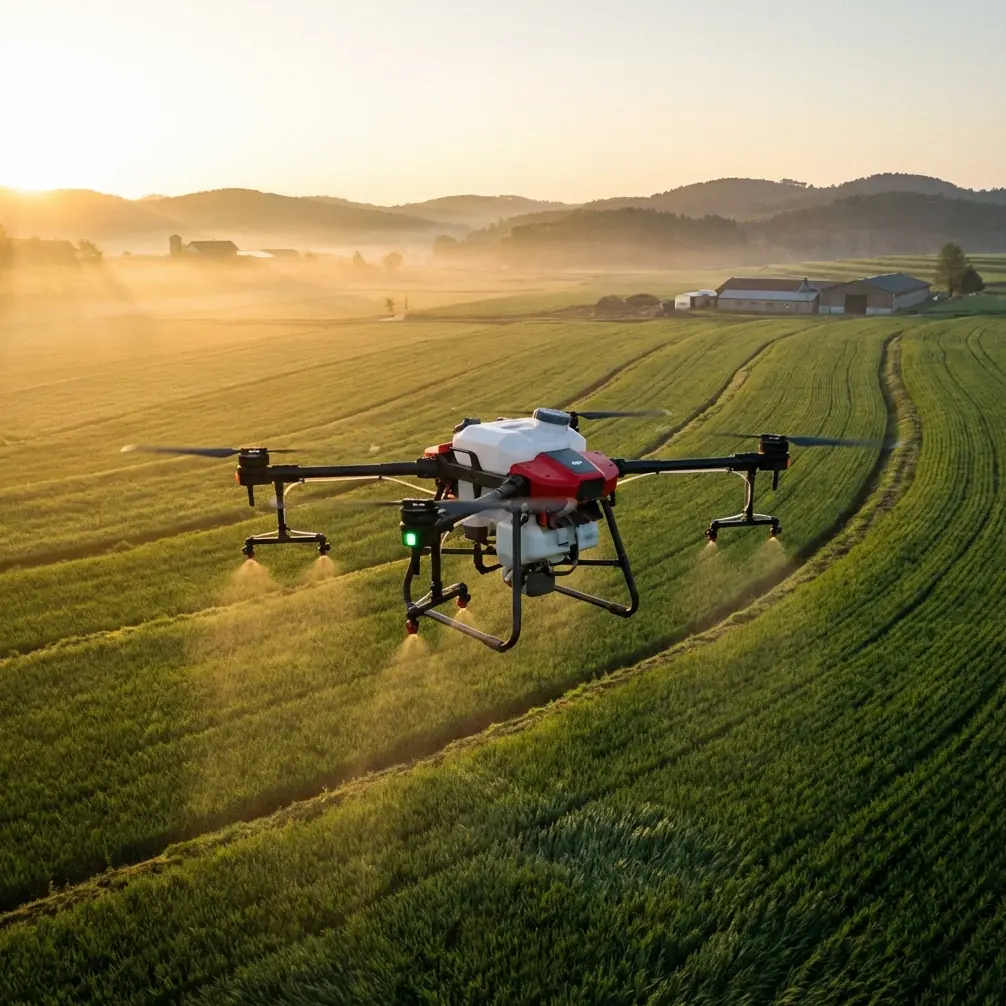
Agras T70P in Low Light: A Field Report on Flight Height, Battery Reality, and Why Supply Chains Now Matter
META: Practical Agras T70P field report for low-light work, with guidance on flight altitude, RTK reliability, nozzle calibration, spray drift control, and the battery supply-chain pressures shaping real operations.
Low-light fieldwork exposes the difference between a drone that looks capable on paper and one that holds up when visibility drops, humidity rises, and every pass has to count. For operators working with the Agras T70P, the conversation usually starts with flight settings: altitude, swath overlap, nozzle behavior, and whether the aircraft can maintain clean line discipline when the field loses contrast near dusk or dawn.
But there is a second layer that deserves more attention. The machine in the field is only as resilient as the industrial system behind it. Recent reporting from DroneLife, citing a new U.S. Geological Survey study, pointed to something bigger than a single airframe generation: lithium deposits in the eastern United States may be large enough to meet domestic demand for generations. That matters because lithium remains a core battery material, and agricultural UAVs live or die by battery logistics. At the same time, the same report stressed that major gaps still remain in the U.S. battery supply chain. For T70P operators, that means a simple truth: battery chemistry may be improving, but battery availability, serviceability, and replacement continuity are still strategic issues, not just procurement details.
This field report looks at the Agras T70P through that lens, with one specific mission in mind: capturing fields in low light. The focus here is practical. How high should you fly? What changes when ambient light falls off? And why should a battery-supply headline influence the way you plan a spray or imaging session?
The low-light problem is not really about darkness
Calling it a “low-light” problem can be misleading. The T70P is not just fighting darkness. It is dealing with reduced visual texture across the crop canopy, more difficult depth judgment at the field edge, and a narrower margin for small setup errors. A flight profile that seems stable at midday can become less forgiving when the field surface flattens visually and tiny position deviations begin to affect coverage.
That is where centimeter precision and RTK behavior become operational, not promotional, concepts.
If your RTK fix rate is strong and stable, the T70P can hold tighter path consistency across repeated passes. In low light, that matters for two reasons. First, it reduces overlap waste. Second, it helps preserve a uniform application pattern when the operator cannot rely on visual cues alone. If the fix is inconsistent, the drone may still complete the mission, but the burden shifts back to conservative spacing and slower workflows.
For field capture missions, especially where documentation, variable-rate planning, or comparative crop assessment are part of the workflow, stable georeferencing becomes even more valuable. Even if the payload configuration is centered on application rather than dedicated multispectral mapping, the principle is the same: low-light work rewards positional discipline. A drone that can repeatedly hit the same corridor with centimeter-level confidence gives the operator room to lower stress and improve repeatability.
Optimal flight altitude: stay lower than your daytime instinct suggests
For this scenario, the most useful rule is simple: in low light, the best T70P flight altitude is usually slightly lower than what many operators prefer in broad daylight, but not so low that rotor wash starts working against you.
A practical working window for many field conditions is around 3 to 4 meters above the canopy, adjusted for crop height, nozzle type, wind behavior, and target coverage pattern. That number is not magic. It is a balancing point.
Fly too high and several problems stack up quickly. The first is spray drift. The second is weaker deposit consistency at the edge of the swath. The third is that low-light depth perception can tempt operators to hold more altitude “for safety,” which often creates a larger application penalty than they expect. Droplets spend more time in disturbed air, crosswind influence rises, and the effective swath width becomes less trustworthy.
Go too low, and another set of issues appears. Rotor turbulence can disturb the canopy more aggressively, droplet behavior can become erratic, and terrain-following errors matter more. In uneven fields, especially where crop height varies, very low flight margins leave less room for stable passage.
That is why 3 to 4 meters above canopy is often the sweet spot for low-light work on the T70P. It helps preserve droplet energy, tightens pattern control, and keeps the swath width honest without inviting unnecessary drift. Operators chasing efficiency often want to expand coverage width. In dimmer conditions, that instinct should be checked. A slightly narrower but more reliable swath usually beats a broader pass with ambiguous edges.
Swath width should be earned, not assumed
Swath width in low light is one of the easiest places to lose performance without noticing it in real time. In bright conditions, experienced pilots can catch subtle misses or overlap changes by watching crop response and edge alignment. In low light, that feedback weakens.
The safe approach with the T70P is to treat published or previously achieved swath widths as starting points, not guarantees. In the field, actual width depends on droplet size, boom geometry, nozzle health, flight speed, altitude, and the local air behavior at the moment of application.
A tight nozzle calibration routine is not optional here. If one nozzle is beginning to deviate, or if wear has shifted the output profile, low-light conditions can hide the evidence until the field tells the story later. That costs time and credibility.
When preparing the T70P for dusk or dawn work, I’d prioritize these checks in this order:
- Nozzle calibration and flow consistency
- RTK fix stability before takeoff
- Terrain-following confidence over the actual field, not just the map
- A modestly conservative swath width
- Altitude confirmation relative to canopy, not relative to ground at the launch point
That fifth point sounds obvious, yet it causes avoidable mistakes. Launch areas and field interiors are often not level. Low-light work amplifies that mismatch.
Spray drift gets worse when the operator gets ambitious
Spray drift is not only a weather issue. It is often a decision issue.
Near sunrise and sunset, air can feel calmer, which encourages operators to push coverage. Sometimes that works. Sometimes those apparently quiet windows conceal lateral movement just strong enough to pull fine droplets off-pattern. Add a little extra altitude and the penalty compounds.
For the T70P, this is where flight discipline matters more than machine capability. If the mission requires precision deposition, hold the line on altitude and do not inflate forward speed simply because visibility feels manageable. Better to maintain a cleaner application corridor and accept a slightly slower completion time than to recover from drift-related inconsistency later.
Low-light work can also encourage overreliance on automation. Automation helps. It does not cancel aerodynamics. The drone may hold the route exactly, but if the droplets leave the route, the field does not care how accurate the track log looks.
Why a lithium headline belongs in a T70P field discussion
At first glance, the U.S. Geological Survey’s lithium finding seems unrelated to a crop mission. It is not.
The DroneLife report highlighted two linked facts: first, eastern U.S. lithium deposits could potentially satisfy domestic demand for generations; second, the battery supply chain still has major domestic gaps. That pair of facts matters directly to high-duty agricultural UAVs like the T70P because battery operations are not just about chemistry. They are about continuity.
An Agras-class platform working a real farm schedule depends on battery turnover, charging infrastructure, replacement timing, and confidence that the next pack will be available when the current set ages out. A more secure domestic lithium source could strengthen long-term resilience for battery manufacturing. But as the report makes clear, raw material availability does not equal a complete local battery ecosystem.
Operationally, that means T70P owners should think beyond cycle count alone. Battery planning should include:
- replacement lead-time risk
- service support continuity
- charger and pack interoperability planning
- mission scheduling around pack health, not just pack percentage
This is especially relevant in low-light windows, which are often chosen because they offer favorable agronomic timing. If your best application window is narrow, weak battery logistics become a field problem very quickly.
In other words, the USGS finding is encouraging, but the remaining supply-chain gaps still affect how confidently agricultural drone fleets can scale. For a T70P operator, that translates into one practical habit: build redundancy into your power plan.
Reading the market behind the machine
The second reference set may look indirect, but it points to another useful truth. The 2019 China drone market research material from 中商产业研究院 describes a consultancy built around a “five-in-one” system spanning industrial research, planning, strategy, investment, and招商, and notes it has worked with major enterprises, governments, research institutes, and financial institutions for over twenty years. That broad market framing matters because agricultural drones do not develop in isolation. They sit at the intersection of equipment manufacturing, energy systems, data workflows, and capital planning.
Why mention that in a T70P field report? Because the low-light use case is no longer just a pilot skill question. It is part of an industrial stack. The drone, the battery chain, the agricultural service model, and the data expectations are now connected. When a research institution with deep coverage across manufacturing, new energy, new materials, and artificial intelligence treats drones as part of a wider industrial ecosystem, that mirrors what operators are experiencing on the ground.
A T70P deployment today is not merely a flight task. It is a systems task.
That helps explain why low-light capture sessions have become more demanding. Clients and farm managers expect consistent output, traceable routes, cleaner logs, and better repeatability. The aircraft has to deliver, but so does the operating method.
A practical low-light setup philosophy for the Agras T70P
If I were preparing the T70P for a low-light field session, I would build the mission around consistency rather than maximum area per hour.
That means:
- Fly roughly 3 to 4 meters above canopy as a baseline and adjust only after observing canopy response.
- Narrow the assumed swath width until field evidence supports expansion.
- Confirm RTK fix quality before entering the production zone.
- Recheck nozzle calibration instead of trusting the previous day’s setup.
- Watch for drift not just in forecast terms but in actual downfield behavior.
- Manage batteries conservatively if the session sits inside a narrow agronomic window.
If you are trying to document field condition changes at the same time, keep your route geometry repeatable. Low-light comparisons become more useful when the aircraft path is as stable as possible from mission to mission. For teams refining capture protocols or comparing output variables, a short direct discussion with an experienced operator can save a lot of trial time; one practical option is to message a T70P field specialist here.
The real lesson: precision starts before takeoff
The most common low-light mistake with the T70P is not a dramatic crash or obvious failure. It is a subtle setup compromise that quietly spreads across the whole field: a little too much altitude, a little too much trust in swath width, a little too little attention to nozzle condition, or a battery plan that assumes perfect continuity.
What the recent lithium news adds to this picture is perspective. Even as upstream raw-material prospects improve, field operators still live with the realities of incomplete supply chains. And what the broader Chinese market-research context adds is equally useful: agricultural drones now belong to a larger industrial framework where energy, manufacturing, planning, and service execution are tightly linked.
So when someone asks for the best low-light tip for the Agras T70P, my answer is not a single setting. It is a sequence.
Start with RTK confidence. Calibrate the nozzles. Hold altitude around 3 to 4 meters above the canopy. Respect drift. Keep swath width conservative until the field proves otherwise. And treat battery readiness as part of mission quality, not an afterthought.
That is how low-light work becomes repeatable instead of hopeful.
Ready for your own Agras T70P? Contact our team for expert consultation.